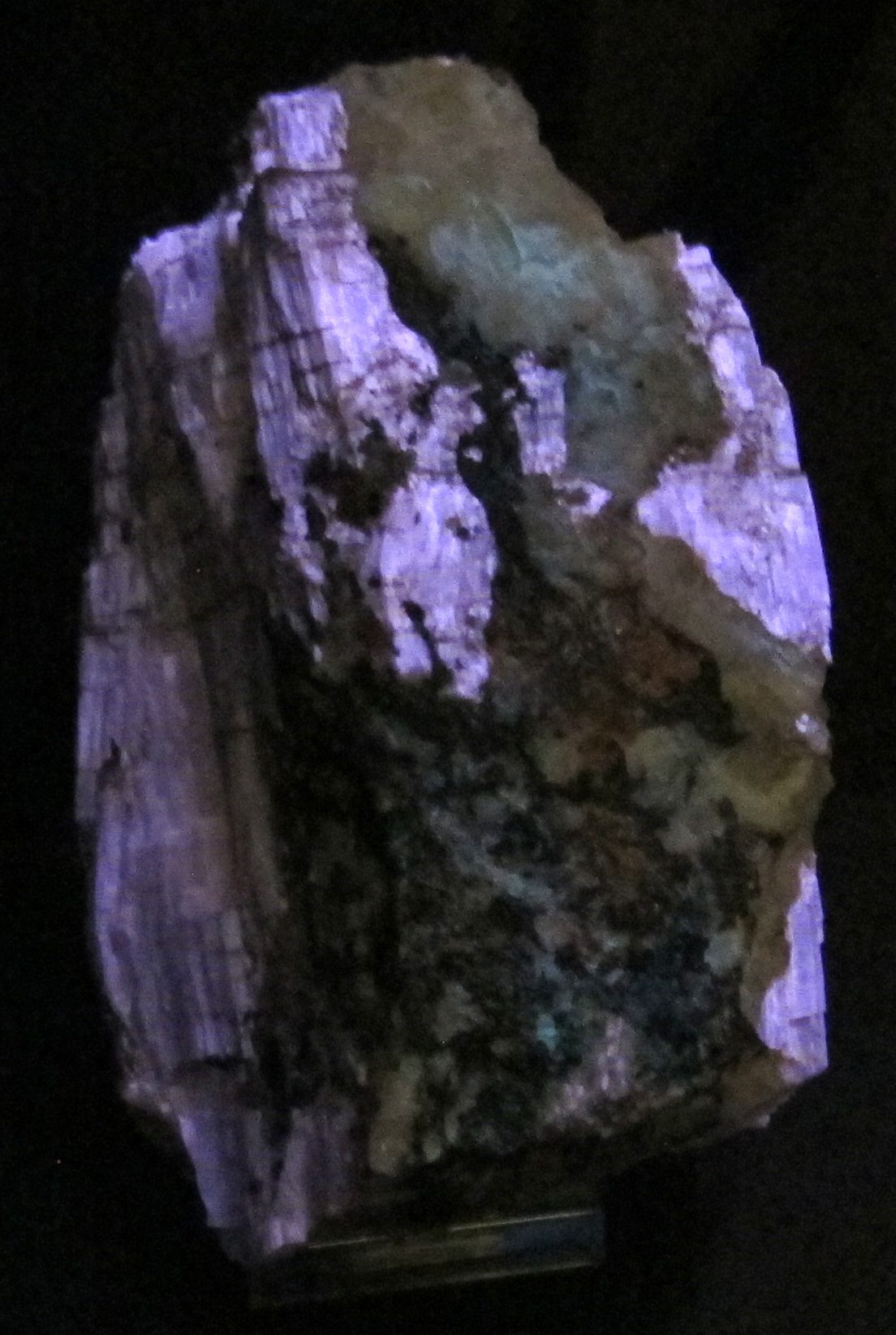
Museo di storia naturale (Florence), Mineralogy section: Fluorescent Agrellite — Photo: Sailko · CC BY-SA 3.0
Agrellite
Agrellite (NaCa2Si4O10F) is a rare triclinic inosilicate mineral with four-periodic single chains of silica tetrahedra. It is a white to grey translucent mineral, with a pearly luster and white streak. It has a Mohs hardness of 5.5 and a specific gravity of 2.8. Its type locality is the Kipawa Alkaline Complex, Quebec, Canada, where it occurs as tabular laths in pegmatite lenses. Other localities include Murmansk Oblast, Russia, Dara-i-Pioz Glacier, Tajikistan, and Saima Complex, Liaoning, China.
Intro adapted from Wikipedia (CC BY-SA).
Agrellite is an IMA-recognized mineral species in the silicate class, with the chemical formula NaCa₂Si₄O₁₀F.
It crystallizes in the triclinic crystal system (space group P-1).
Key properties: Mohs hardness 5.5; specific gravity 2.902; Pearly on cleavages luster; refractive index 1.576; optically biaxial.
IMA symbol Are, IMA status: approved, named in 1973.
Found in pegmatite lenses and pods and in mafic gneisses in a regionally metamorphosed agpaitic alkalic rock complex (Villedieu Township, Canada).
It is found associated with Hiortdahlite, mosandrite, miserite, britholite, vlasovite, calcite, fluorite, clinohumite, gittinsite, norbergite, zircon, biotite, phlogopite.
The mineral was named to honor Professor Stuart Olof Agrell (1913–1996), eminent petrologist, Cambridge University, Cambridge, England.