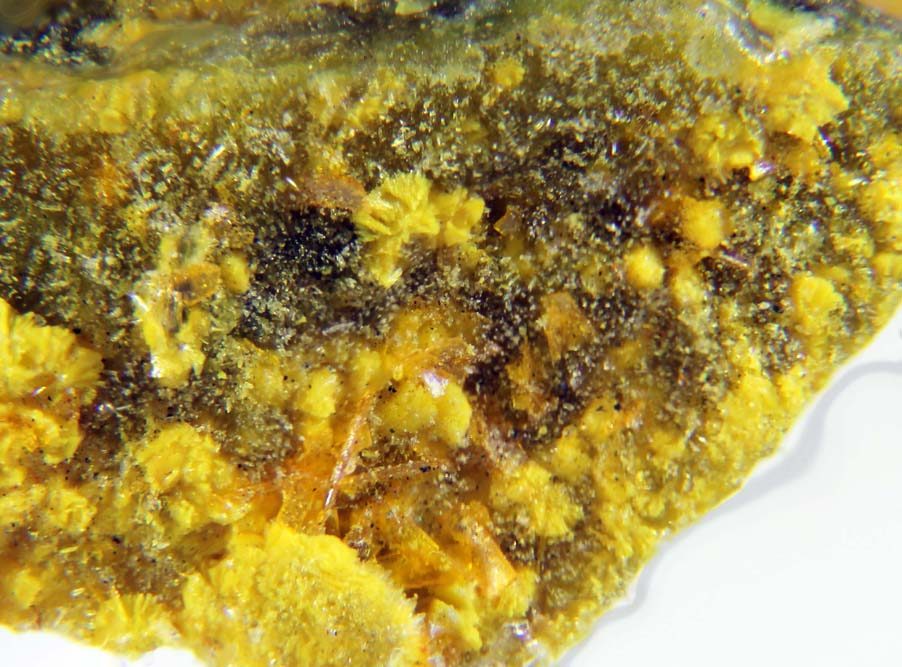
Outstanding yellow crystals of the extremely rare uranium mineral agrinierite from the type and only known locality worldwide: Margnac Mine, Compreignac, Haute-Vienne, Limousin, France. — Photo: David Hospital · CC BY-SA 4.0
Agrinierite
Agrinierite is a mineral often found in the oxidation zone of uranium deposits. It is named after Henry Agrinier (1928–1971), a French engineer for the Commissariat à l'Énergie Atomique (Mineralogy Laboratory of the French Atomic Energy Commission, Paris, France). Agrinierite is a hydrated oxide of uranium discovered during the exploitation of the uranium deposit of Margnac (Haute-Vienne, France), the only site in the world where it is known today.
Intro adapted from Wikipedia (CC BY-SA).
Agrinierite is an IMA-recognized mineral species in the oxides & hydroxide class, with the chemical formula K₂Ca[(UO₂)₃O₃(OH)₂]₂·5H₂O.
It crystallizes in the orthorhombic crystal system (space group F2mm). It is a member of the Compreignacite structural group.
Key properties: specific gravity 5.7; optically biaxial.
IMA symbol Agn, IMA status: approved, named in 1971.
Found in the oxidation zone of a uranium deposit.
It is found associated with Uranophane, “gummite”.
The name refers to Henri Agrinier (1928–1971), an engineer in the Mineralogy Laboratory of the French Atomic Energy Commission, Paris, France.