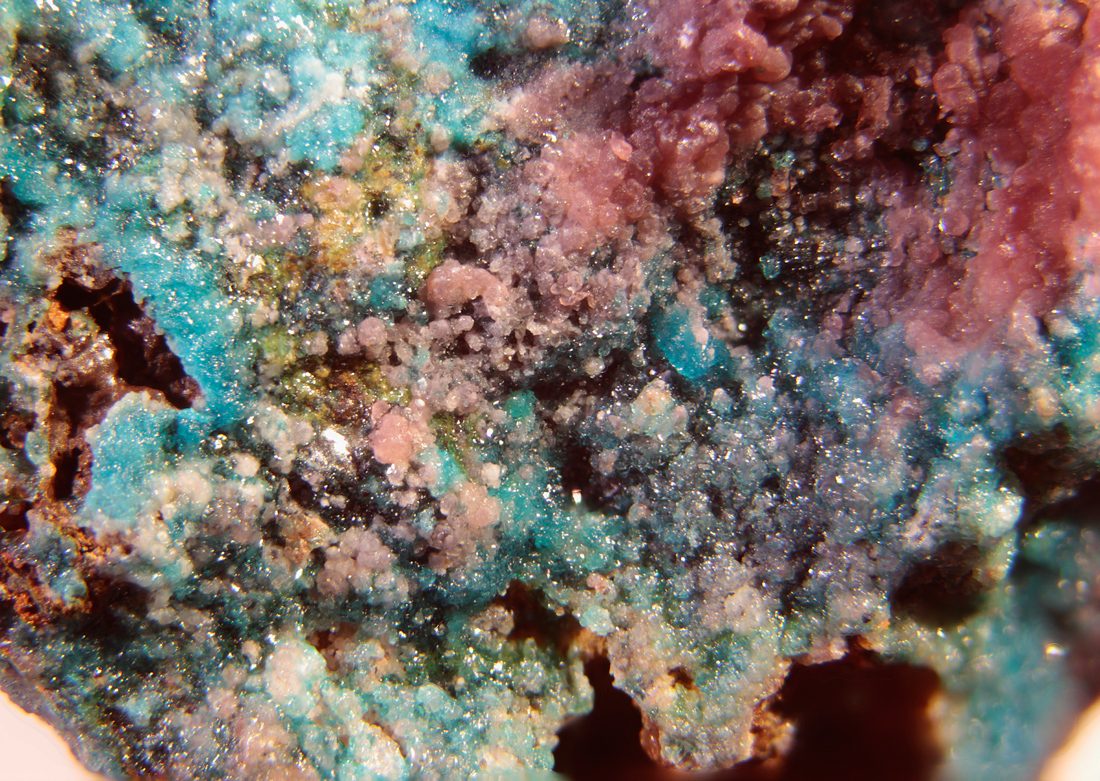
Alfredopetrovite , Ahlfeldite , Chalcomenite Locality: El Dragón Mine, Quijarro Province, Potosi Department, Bolivia Size: 1.3 cm × 0.7 cm × 0.8 cm Description: Druse of tiny alfredopetrovite crystals, colorless to greyish tone, coating over blue chalcomenite and pink ahlfeldite. Some areas, with no colored background minerals, let us to see perfectly crystals. You can also observe face reflections of this extremely rare species. Alfredopetrovite is the first aluminium selenite mineral. On a kruťait-penroseite matrix. — Photo: Joan Rosell , from rosellminerals.com · CC BY-SA 4.0
Ahlfeldite
Ahlfeldite ((Ni, Co)SeO3]·2H2O) is a mineral of secondary origin. It is named after Friedrich Ahlfeld (1892–1982), a German-Bolivian mining engineer and geologist. Its type locality is Virgen de Surumi mine, Pakajake Canyon, Chayanta Province, Potosí Department, Bolivia.
Intro adapted from Wikipedia (CC BY-SA).
Ahlfeldite is an IMA-recognized mineral species in the oxides & hydroxide class, with the chemical formula Ni(SeO₃)·2H₂O.
It crystallizes in the monoclinic crystal system (space group P2_1/n). It is a member of the Cobaltomenite structural group.
Key properties: Mohs hardness 2–2.5; specific gravity 3.37; Vitreous luster; optically biaxial.
IMA symbol Afe, grandfathered status — known before the IMA’s founding, named in 1935.
A rare alteration product of nickel-bearing selenides and sulfides.
It is found associated with Penroseite, chalcomenite, olsacherite, cerussite, anglesite (Pacajake mine, Bolivia); chalcomenite, olsacherite, lepidocrocite, goethite (El Dragón mine.
The mineral was named to honor Friedrich E. Ahlfeld (1892–1982) German–Bolivian mining engineer and mineralogist.