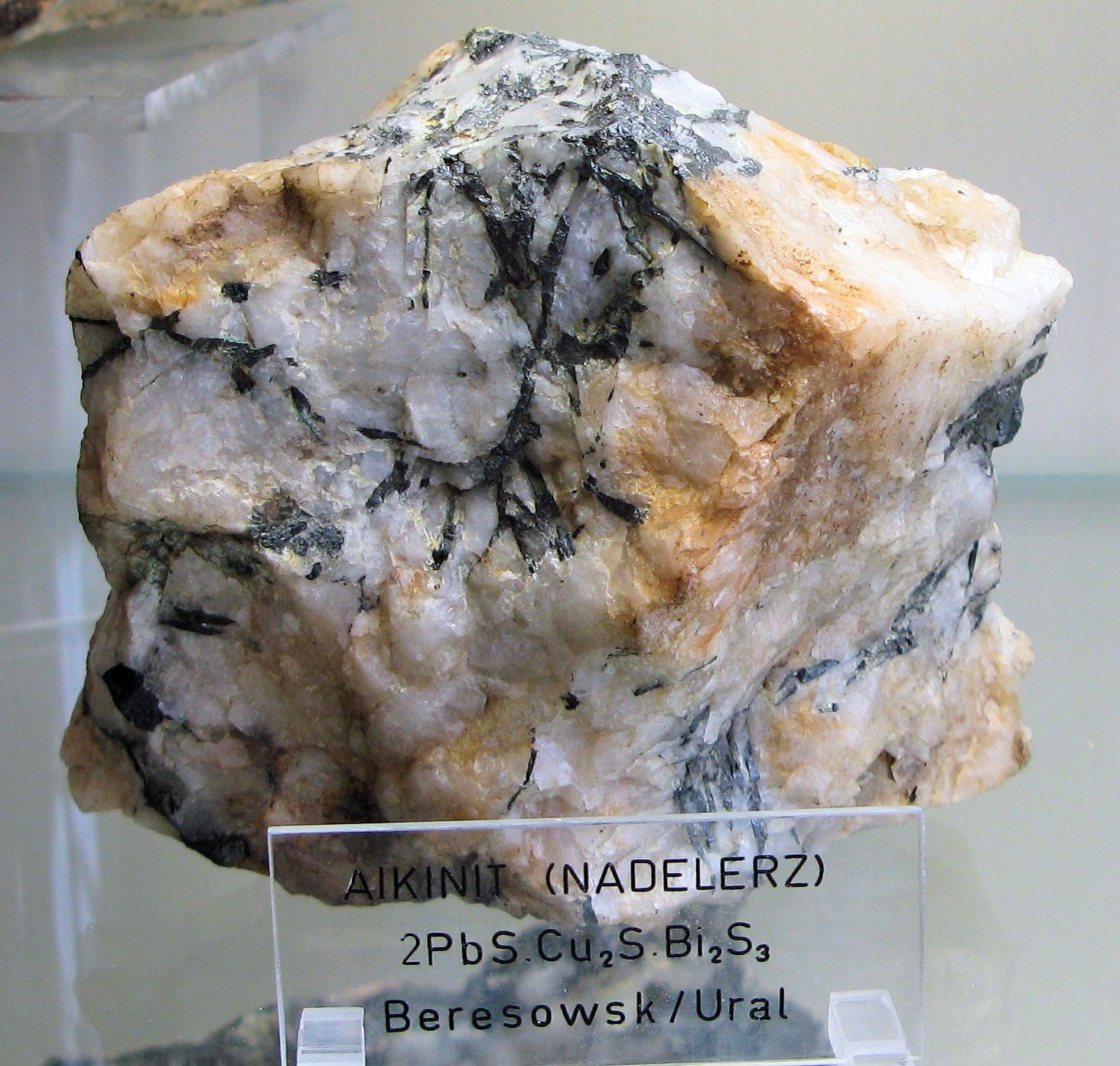
Aikinite - Locality: Beresowsk, Ural - Exposed in the Mineralogical Museum, Bonn, Germany — Photo: Ra'ike (see also: de:Benutzer:Ra'ike ) · CC BY-SA 3.0
Aikinite
Aikinite is a sulfide mineral of lead, copper and bismuth with formula Pb Cu Bi S3. It forms black to grey or reddish brown acicular orthorhombic crystals with a Mohs hardness of 2 to 2.5 and a specific gravity of 6.1 to 6.8. It was originally found in 1843 in the Beryozovskoye deposit, Ural Mountains. It is named after Arthur Aikin (1773–1854), an English geologist. It has been found in Western Tasmania, in mines located near Dundas, Tasmania.
Intro adapted from Wikipedia (CC BY-SA).
Aikinite is an IMA-recognized mineral species in the sulfosalt class, with the chemical formula CuPbBiS₃.
It crystallizes in the orthorhombic crystal system (space group Pnma). It is a member of the Meneghinite structural group.
Key properties: Mohs hardness 2–2.5; specific gravity 7.07; Grayish black streak; Metallic luster.
IMA symbol Aik, grandfathered status — known before the IMA’s founding, named in 1843.
Uncommon in hydrothermal veins.
It is found associated with Gold, pyrite, galena, tennantite, bismuthinite, enargite, chalcopyrite, quartz.
The name refers to Dr. Arthur Aikin (1773–1854), English chemist and mineralogist, a founder and long-time Secretary of the Geological Society of London, England.