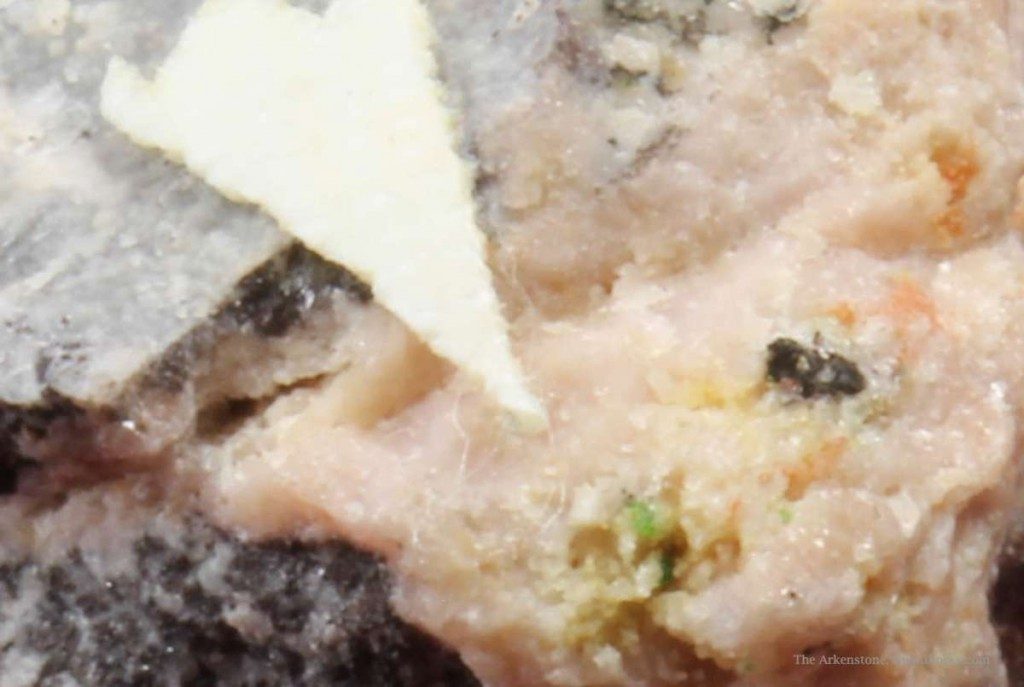
Eveite , Akrochordite Locality: Långban, Filipstad, Värmland, Sweden Dimensions: 1.5 cm x 1.0 cm x 1.0 cm Extremely rare, co-type material from the type locality at Langban. Bright green, vitreous, <0.5mm cluster of eveite hosted within a small vug. Accompanied by other eveite fragments and brown, subhedral akrochordite in a contrasting, pink, granular carbonate matrix. Includes old detailed A. F. Eadie and Topaz-Mineral Exploration labels. Ex. Rock Currier collection. Tom and Melissa Campbell photos. — Photo: Robert M. Lavinsky · CC BY-SA 3.0
Akrochordite
A rare pinkish hydrated manganese-magnesium arsenate, typical of the family of uncommon manganese arsenates.
Intro adapted from Wikipedia (CC BY-SA).
Akrochordite is an IMA-recognized mineral species in the arsenate class, with the chemical formula Mn²⁺₅(AsO₄)₂(OH)₄·4H₂O.
It crystallizes in the monoclinic crystal system (space group P2_1/c). It is a member of the Akrochordite structural group.
Key properties: Mohs hardness 3.5; specific gravity 3.19–3.35; Dull luster; optically biaxial.
IMA symbol Akr, grandfathered status — known before the IMA’s founding, named in 1922.
A rare mineral found in hausmannite ore from a metamorphosed Fe–Mn orebody (Långban, Sweden); in a metamorphosed stratiform zinc orebody (Sterling Hill, New Jersey, USA).
It is found associated with Pyrochroite, barite, hausmannite, eveite, brandtite (Långban, Sweden); sarkinite, chlorophoenicite, carbonates (Sterling Hill, New Jersey, USA).
Its name comes from the Greek for wart, for its typical habit.