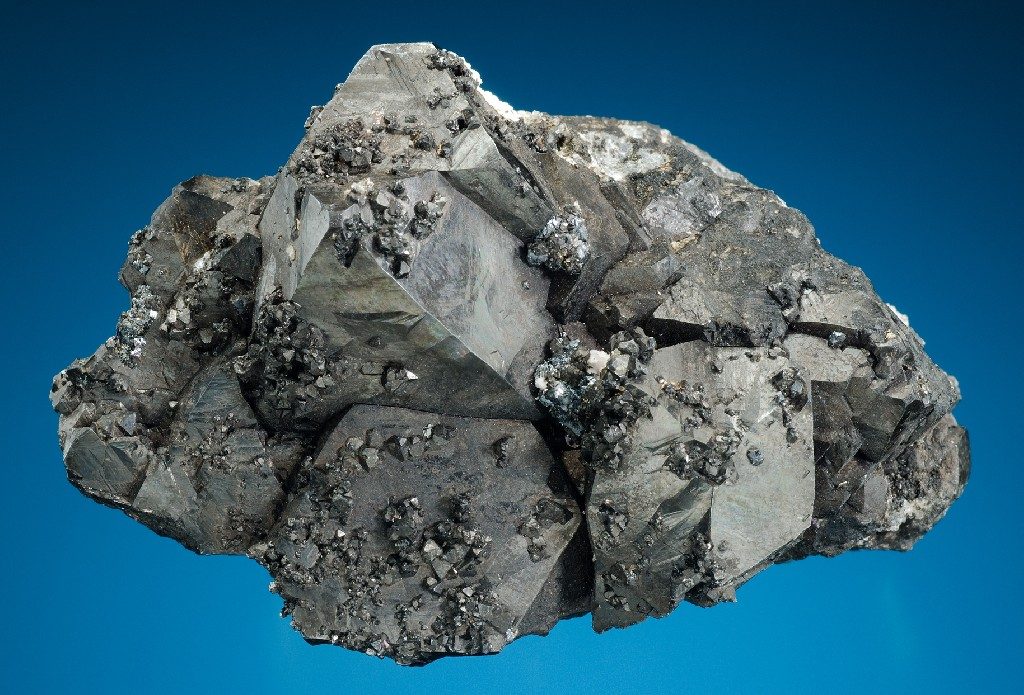
Alabandite - Locality: Uchucchacua Mine, Oyon Province, Lima Department, Peru - A cluster of alabandite crystals, the largest of which is about 2.5 cm. The specimen is 7.5 x 3.8 cm. The small crystals growing on the larger ones are also alabandite. There are some small crystals of proustite and another unknown minerals also on the specimen but not readily apparent on the photo. The specimen is in the collection of Bill Pinch, of Tucson Arizona. The specimen was purchased in Lima Peru by Jaroslav Hyrsl from an old collection. It was by far the best specimen of the species in the collection. It is not known how many specimens of alabandite that Uchucchacua has produced but if it has produced many alabandite specimens, few of them have survived. The miners know to look for and save rhodochrosite and silver speckmens from the mine, but black minerals like alabandite are most likely to just be run through the crushers or thrown out on the dump. — Photo: Rock Currier · CC BY 3.0
Alabandite
An uncommon manganese sulfide that usually forms granular masses, though it can produce small cubic or octahedral crystals.
Intro adapted from Wikipedia (CC BY-SA).
Alabandite is an IMA-recognized mineral species in the sulfide class, with the chemical formula MnS.
It crystallizes in the cubic crystal system (space group Fm3m). It is a member of the Rocksalt structural group.
Key properties: Mohs hardness 3.5–4; specific gravity 3.95–4.04; Submetallic luster.
IMA symbol Abd, grandfathered status — known before the IMA’s founding, named in 1822.
May be in large quantities in epithermal polymetallic sulfide vein and especially in low-temperature manganese deposits. An uncommon constituent of a number of meteorites.
It is found associated with Galena, chalcopyrite, sphalerite, pyrite, acanthite, tellurium, rhodochrosite, calcite, rhodonite, quartz.
The name refers to the originally reported locality at Alabanda in Turkey.