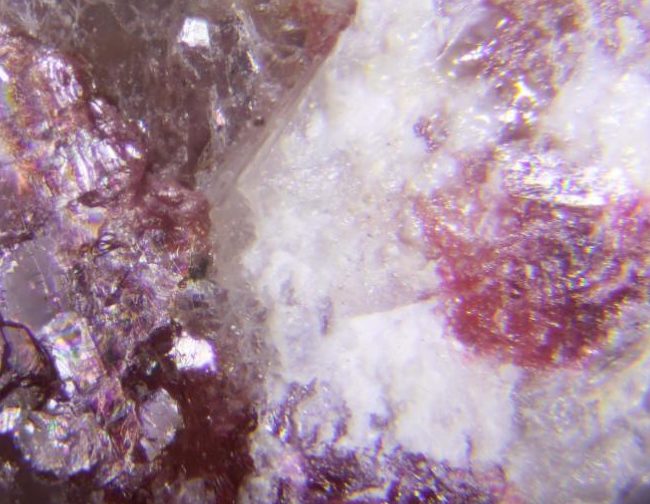
White vitreous microinclusions of the extremely rare Ba phosphate chloride mineral alforsite associated to rose red gillespite from California (Trumbull Peak, Mariposa County, California, United States of America). Ex Vandenbroucke Museum collection from Waregem, Belgium. — Photo: David Hospital · CC BY 4.0
Alforsite
Alforsite is a barium phosphate chloride mineral with formula: Ba5(PO4)3Cl. It was discovered in 1981, and named to honor geologist John T. Alfors (1930–2005) of the California Geological Survey for his work in the area where it was discovered. Alforsite is a hexagonal colorless crystal in the chemical class phosphates and the group apatite. It is found in certain parts of central California, primarily Fresno, Mariposa, and Tulare Counties. It has also been found in Baja California, Mexico. Alforsite is a constituent of the apatite group of minerals.
Intro adapted from Wikipedia (CC BY-SA).
Alforsite is an IMA-recognized mineral species in the phosphate class, with the chemical formula Ba₅(PO₄)₃Cl.
It crystallizes in the hexagonal crystal system (space group P6_3/m). It is a member of the Apatite structural group.
Key properties: Mohs hardness 5; specific gravity 4.765; refractive index 1.7; optically uniaxial.
IMA symbol Afr, IMA status: approved, named in 1980.
Found in lenses and bands of barium silicate metasediments developed under hornblende-pyroxene hornfels facies near the contact with granite or granodiorite.
It is found associated with Celsian, witherite, sanbornite, gillespite, fresnoite, fluorapatite, walstromite, titantaramellite, quartz, tourmaline, pyrite.
The mineral was named to honor Dr. John T. Alfors (1930–), geologist, California Division of Mines, for his work on the type locality.