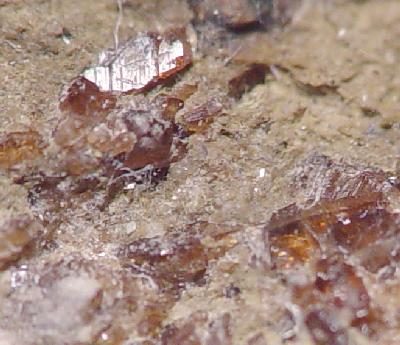
Alleghanyite Locality: Sterling Mine, Sterling Hill , Ogdensburg , Franklin Mining District, Sussex County, New Jersey , USA ( Locality at mindat.org ) Alleghanyite is an exceptionally rare member of the humite group, and this specimen is unusually rich with gemmy brown microcrystals to 2 mm flatlaying along an approximately 3-cm vertical axis on this specimen . The matrix is a typical mix of franklinite/calcite/willemite and is highly fluorescent. 11 x 6.5 x 4 cm — Photo: Robert M. Lavinsky · CC BY-SA 3.0
Alleghanyite
Alleghanyite is a moderately rare humite mineral with formula Mn5(SiO4)2(OH)2, belonging to the nesosilicates class. In general its occurrences are related with metamorphic (metamorphosed) manganese deposits. The mineral is named after Alleghany County, North Carolina, US.
Intro adapted from Wikipedia (CC BY-SA).
Alleghanyite is an IMA-recognized mineral species in the silicate class, with the chemical formula Mn²⁺₅(SiO₄)₂(OH)₂.
It crystallizes in the monoclinic crystal system (space group P2_1/b). It is a member of the Humite structural group.
Key properties: Mohs hardness 5.5; specific gravity 4.02; Vitreous to dull luster; refractive index 1.776; optically biaxial.
IMA symbol Alh, grandfathered status — known before the IMA’s founding, named in 1932.
Hydrothermally deposited, in lenses in a manganese-bearing vein (Bald Knob, North Carolina, USA); in veins crosscutting franklinite ore near pegmatites in a metamorphosed stratiform Zn{Mn deposit (Franklin, New Jersey, USA).
It is found associated with Spessartine, rhodonite, galaxite (Bald Knob, North Carolina, USA); kolicite, holdenite, magnussonite, adelite, kraisslite, chlorophoenicite, franklinite.
The name refers to the occurrence in Alleghany Co., North Carolina, USA.