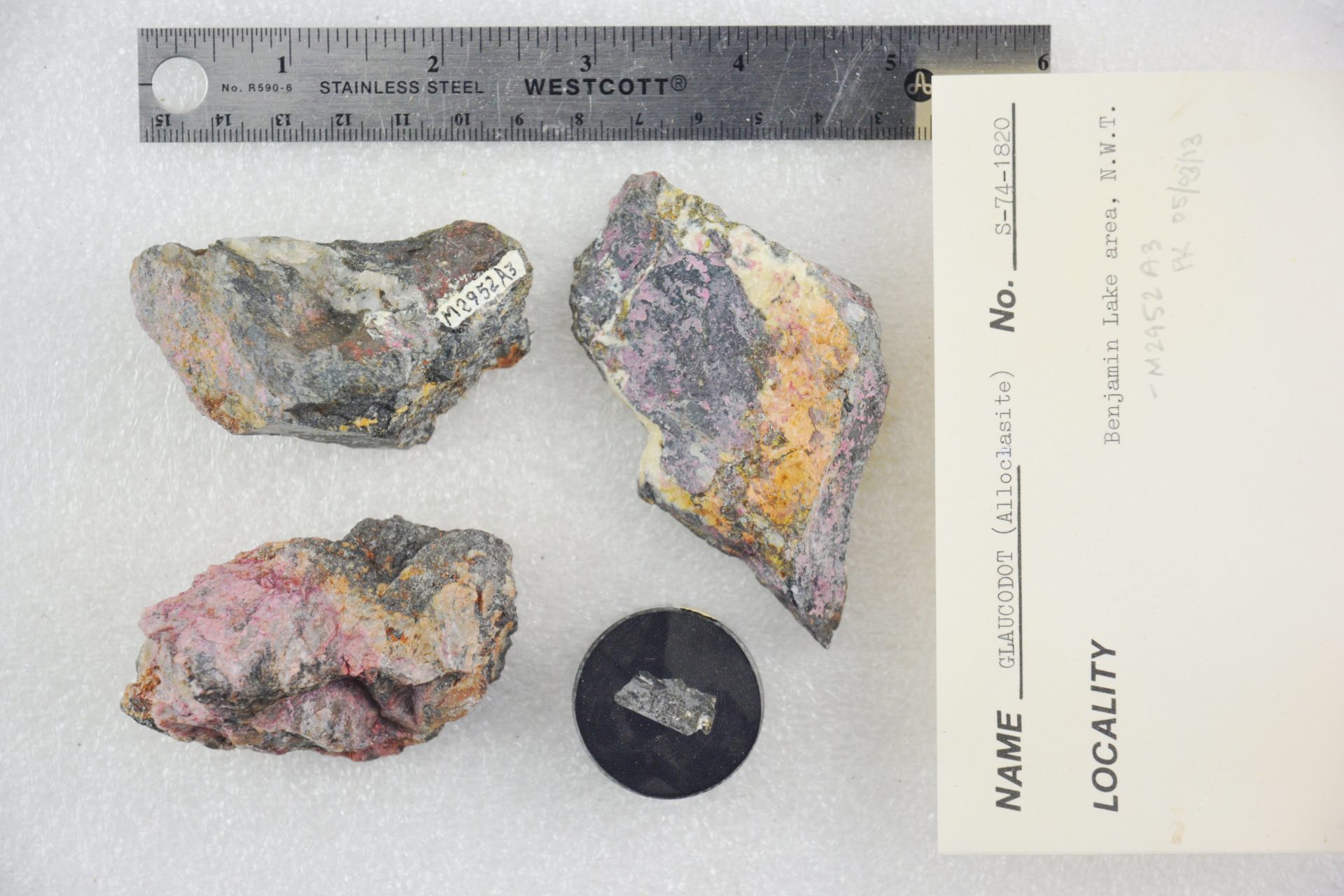
Benjamin Lake Area Northwest Territories, Canada S-74-1820 — Photo: Pacific Museum of Earth from Canada · CC BY-SA 2.0
Alloclasite
Alloclasite, or (Co,Fe)AsS, is a sulfosalt mineral (IMA symbol: Acl). It is a member of the arsenopyrite group. Alloclasite crystallizes in the monoclinic system and typically forms as columnar to radiating acicular prismatic clusters. It is an opaque steel-gray to silver-white, with a metallic luster and a black streak. It is brittle with perfect cleavage, a Mohs hardness of 5 and a specific gravity of 5.91–5.95. It was first described in 1866 for an occurrence in Romania.
Intro adapted from Wikipedia (CC BY-SA).
Alloclasite is an IMA-recognized mineral species in the sulfosalt class, with the chemical formula CoAsS.
It crystallizes in the monoclinic crystal system (space group P2_1). It is a member of the Löllingite structural group.
Key properties: Mohs hardness 5; specific gravity 5.91–5.95; Nearly black streak; Bright metallic. R1 –R2: (400) 49.5–48.2, (420) 48.7–48.3, (440) 48.2–48.6, (460) 47.8–48.8, (480) 47.6–49.2 luster.
IMA symbol Acl, grandfathered status — known before the IMA’s founding, named in 1866.
Found in calcite or quartz veins of apparently low-temperature, late-stage hydrothermal origin. Also in silicified, recrystallized metamorphic rock.
It is found associated with Gold, silver, glaucodot, cobaltite, cobaltian arsenopyrite, emplectite, bismuthinite, sphalerite, calcite, quartz.
Its name comes from the Greek for other, and to break, because its cleavage was believed to be different from marcasite, which it resembles.