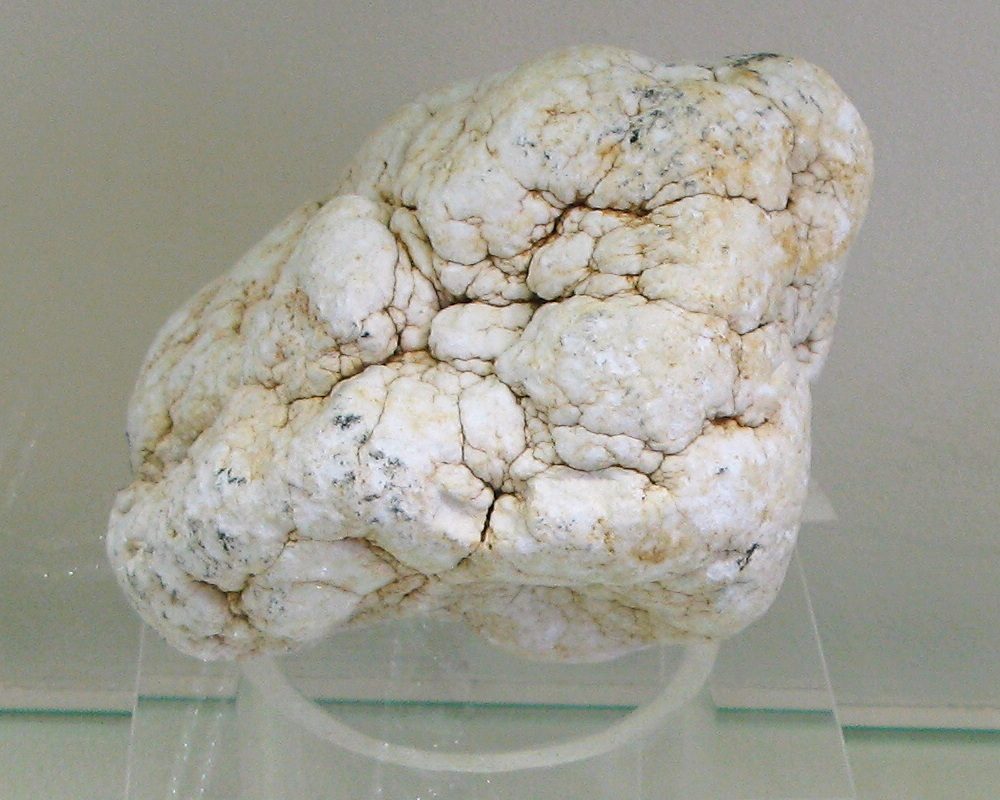
Aluminite - Locality: Newhaven, Sussex, England - Exposed in the Mineralogical Museum, Bonn, Germany — Photo: Ra'ike (see also: de:Benutzer:Ra'ike ) · CC BY-SA 3.0
Aluminite
A hydrous aluminium sulfate that forms white, earthy, botryoidal masses and almost never shows crystal faces.
Intro adapted from Wikipedia (CC BY-SA).
Aluminite is an IMA-recognized mineral species in the sulfate class, with the chemical formula Al₂(SO₄)(OH)₄·7H₂O.
It crystallizes in the monoclinic crystal system (space group P2_1/c). It is a member of the Aluminite structural group.
Key properties: Mohs hardness 1–2; specific gravity 1.66–1.82; Dull to earthy luster; refractive index 1.464; optically biaxial.
IMA symbol A, grandfathered status — known before the IMA’s founding, named in 1805.
is typically found in clays or lignites, formed by the reaction of sulfate-bearing solutions from the decomposition of marcasite or pyrite at moderate temperatures with aluminous silicates; as a volcanic sublimate; in sulfur deposits.
It is found associated with Basaluminite, gibbsite, epsomite, gypsum, celestine, dolomite, goethite.
The name refers to aluminum in the composition.