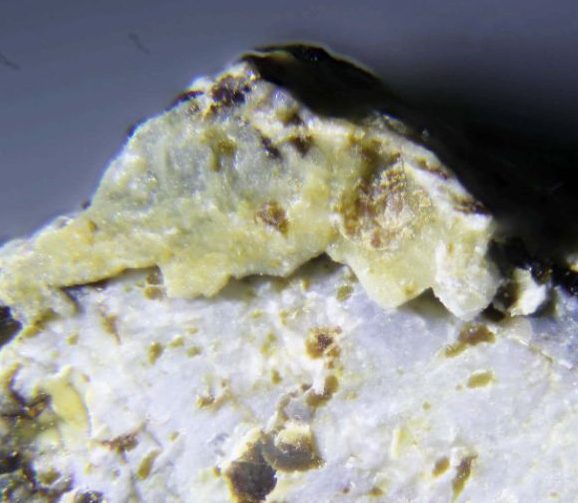
White and yellow crystal aggregates of the rare mineral Para-alumohydrocalcite from the type locality in Russia: Vodinskoe, Samara Oblast, Russian Federation. Ex Vandenbroucke Museum collection from Waregem, Belgium. — Photo: David Hospital · CC BY-SA 4.0
Alumohydrocalcite
A calcium-aluminium carbonate hydrate first described from Khakassia, Russia.
Intro adapted from Wikipedia (CC BY-SA).
Alumohydrocalcite is an IMA-recognized mineral species in the carbonate class, with the chemical formula CaAl₂(CO₃)₂(OH)₄·4H₂O.
It crystallizes in the triclinic crystal system (space group P-1). It is a member of the Alumohydrocalcite structural group.
Key properties: Mohs hardness 2.5; specific gravity 2.21–2.24; Vitreous to pearly, earthy luster; optically biaxial.
IMA symbol Ahcal, IMA status: approved, named in 1926.
Formed at low temperature by the action of carbonated waters on allophane or dickite in dolomites and limestones; chromian varieties are typically formed near altering chromite from serpentinites.
It is found associated with Allophane, dickite, gibbsite, gypsum, aragonite, barite, Fe–Mn oxides.
The name comes from aluminum; water, hydro; and calcium carbonate, calcite, in the composition.