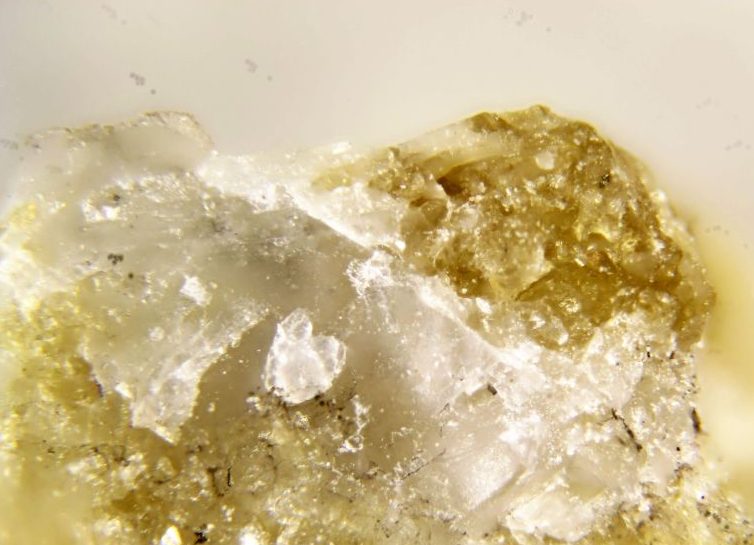
Yellowish brown crystal aggregates of the extremely rare Fe hydroxide mineral amakinite from a locality in Norway (Snarum, Modum, Viken, Norway). Ex Vandenbroucke Museum collection from Waregem, Belgium. — Photo: David Hospital · CC BY-SA 4.0
Amakinite
Amakinite (IMA symbol: Amk) is a semi transparent yellow-green hydroxide mineral belonging to the brucite group that was discovered in 1962. Its chemical formula is written as (Fe2+,Mg)(OH)2. It usually occurs in the form of splotchy, anhedral crystals forming within a group or structure in other minerals or rocks, such as kimberlite (occurring in diamond-rich eruptive pipe).
Intro adapted from Wikipedia (CC BY-SA).
Amakinite is an IMA-recognized mineral species in the oxides & hydroxide class, with the chemical formula Fe(OH)₂.
It crystallizes in the hexagonal crystal system (space group R-3m). It is a member of the Brucite structural group.
Key properties: Mohs hardness 3.5–4; specific gravity 2.92–2.98; optically uniaxial.
IMA symbol Amk, IMA status: approved, named in 1962.
Noted in drill core, in thin veins and pockets in kimberlite.
It is found associated with Serpentine, carbonate.
The name refers to the Amakin Expedition, which prospected the Sakhan diamond deposits.