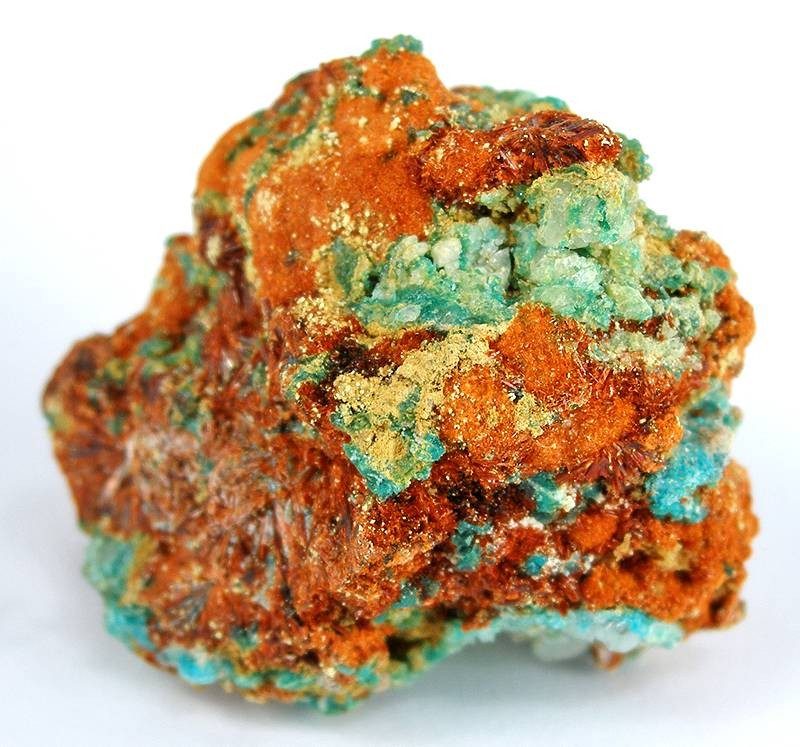
Amarantite , Hohmannite Locality: Queténa Mine, Toki Cu deposit, Chuquicamata District, Calama , El Loa Province , Antofagasta Region , Chile ( Locality at mindat.org ) Size: 3.9 x 3.9 x 2.3 cm. Two beautiful orange iron-containing minerals, both very rare, richly presented on one specimen! The piece shows sharp, flat-laying, acicular crystals of Amarantite in sprays to perhaps 5mm. In person, these crystals have a robust, electric orange-red flare to them and are quite eye-visible. Mixed in (close-up photo) are small tufts or ball-shaped clusters of microcrystalline Hohmannite. Associated minerals are Metahohmannite, Kornelite , Chalcanthite, Copiapite, and Picromerite, I am told. — Photo: Robert M. Lavinsky · CC BY-SA 3.0
Amarantite
Amarantite is an amaranth-red to brownish mineral with the general formula of Fe3+2O(SO4)2·7H2O or Fe3+SO4(OH)·3H2O. The name comes from the Greek word αμάραντος which means amaranth, an imaginary undying red flower, in allusion to its color. Amarantite is triclinic, which means crystallographically, it has only one symmetry fold. It must be rotated 360 degrees to be exactly the same. Due to it being triclinic it falls into the biaxial optical class, the axis degrees do not equal 90 degrees and the sides of each axis are not the same length.
Intro adapted from Wikipedia (CC BY-SA).
Amarantite is an IMA-recognized mineral species in the sulfate class, with the chemical formula Fe³⁺₂O(SO₄)₂·7H₂O.
It crystallizes in the triclinic crystal system (space group P-1). It is a member of the Amarantite structural group.
Key properties: Mohs hardness 2.5; specific gravity 2.19–2.29; Lemon-yellow streak; Vitreous luster; refractive index 1.578; optically biaxial.
IMA symbol Ama, grandfathered status — known before the IMA’s founding, named in 1888.
A secondary mineral formed especially in arid climates.
It is found associated with Hohmannite, fibroferrite, chalcanthite, copiapite, coquimbite, sideronatrite.
Its name comes from the Greek for amaranth, an imaginary purplish red undying flower, for its color.