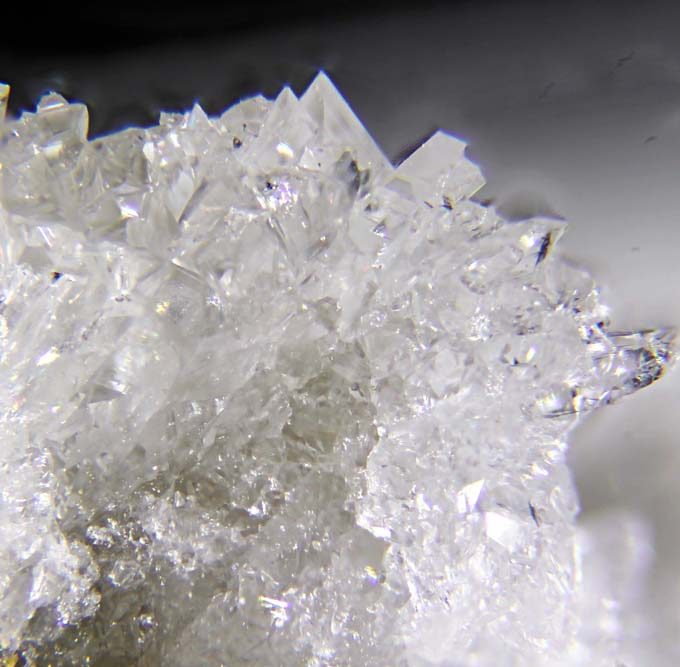
Outstanding colorless crystals of the rare mineral amicite from the type locality (Höwenegg Quarry, Hegau, Baden-Württemberg, Germany). — Photo: David Hospital · CC BY-SA 4.0
Amicite
A rare potassium-sodium zeolite described in 1979 from the Höwenegg quarry in Germany's Hegau region.
Intro adapted from Wikipedia (CC BY-SA).
Amicite is an IMA-recognized mineral species in the silicate class, with the chemical formula K₂Na₂(Al₄Si₄O₁₆)·5H₂O.
It crystallizes in the monoclinic crystal system (space group I2). It is a member of the Gismondine structural group.
Key properties: Mohs hardness 4.5; specific gravity 2.06–2.23; White streak; Vitreous. Streak: White luster; refractive index 1.49; optically biaxial.
IMA symbol Ami, IMA status: approved, named in 1979.
Found in veinlets cutting melilite-nephelinite volcanic rocks and pyroclastics (Hegau, Germany); in natrolite veinlets cutting ijolite-urtite pegmatites and apatite-nepheline rocks (Kola Peninsula, Russia).
It is found associated with Merlinoite, aragonite, calcite (Hegau, Germany); natrolite (Kola Peninsula, Russia).
The mineral was named to honor Giovan Battista Amici (1786–1863), physicist, optician, and inventor of microscope optical elements.