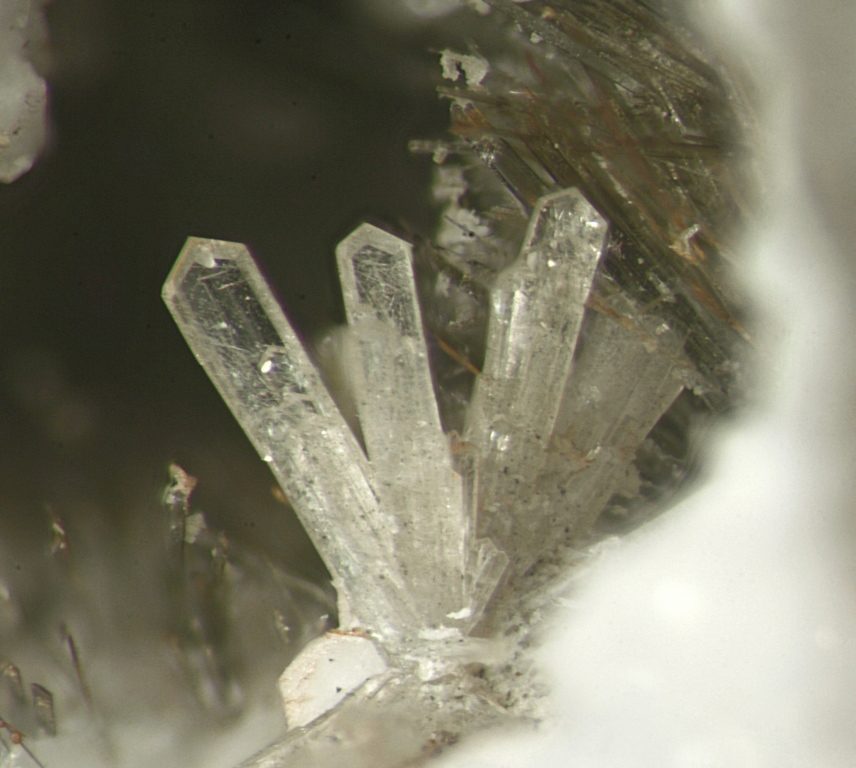
Locality: Demix-Varennes quarry, Saint-Amable sill, Varennes & St-Amable, Lajemmerais RCM, Montérégie, Québec, Canada FOV 2.4 x 2.1 mm. Via Jean-Pierre Beckerich. From an analyzed find. MOB coll. Small but very sharply formed xls. The ancylite on this specimen looks colorless even under tungsten lighting. — Photo: Modris Baum · CC0
Ancylite-(Ce)
Ancylite is a group of hydrous strontium carbonate minerals containing cerium, lanthanum and minor amounts of other rare-earth elements. The chemical formula is Sr(Ce,La)(CO3)2(OH)·H2O with ancylite-Ce enriched in cerium and ancylite-La in lanthanum. Ancylite was first described in 1899 for an occurrence in the Narsarsuk pegmatite in west Greenland and named from the Ancient Greek: ἀγκύλος for curved in reference to its rounded or distorted crystal form.
Intro adapted from Wikipedia (CC BY-SA).
Ancylite-(Ce) is an IMA-recognized mineral species in the carbonate class, with the chemical formula CeSr(CO₃)₂(OH)·H₂O.
It crystallizes in the orthorhombic crystal system (space group Pmc2_1). It is a member of the Ancylite structural group.
Key properties: Mohs hardness 4–4.5; specific gravity 3.82–4.3; White streak; Vitreous to dull on crystal faces, greasy on fracture surfaces luster; optically biaxial.
IMA symbol Anc-Ce, IMA status: approved, named in 1901.
Occurs as an uncommon accessory mineral in some nepheline syenites and carbonatites.
It is found associated with Parisite-(Ce), synchysite-(Y), cordylite-(Ce), eudidymite, aegirine, microcline.
Its name comes from the Greek for curved, in allusion to the characteristically curved crystals.