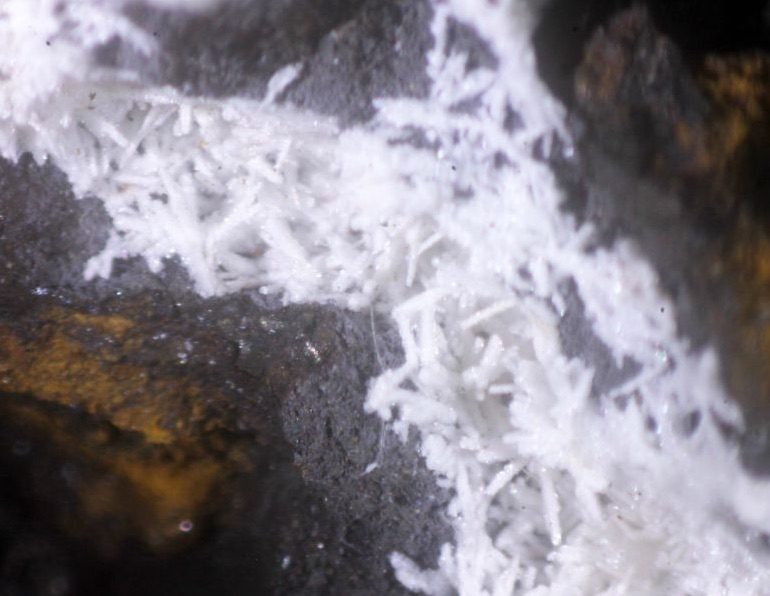
Outstanding acicular white crystals of the very rare phosphate mineral angastonite intermixed with the extremely rare elliottite (IMA 2021-113) from the type locality for both minerals in Penrice quarry, Angaston, Australia. Both minerals are visually indistinguishable. Ex. Erich Laskowski collection. — Photo: David Hospital · CC BY-SA 4.0
Angastonite
Angastonite is an IMA-recognized mineral species in the phosphate class, with the chemical formula CaMgAl₂(PO₄)₂(OH)₄·7H₂O.
It crystallizes in the amorphous crystal system (space group P-1).
Key properties: Mohs hardness 2; specific gravity 2.47; White streak; Pearly luster; optically biaxial.
IMA symbol Ags, IMA status: approved, named in 2008.
Found in phosphate mineralization in a gossanous weathered zone above recrystallized limestone (now marble).
It is found associated with Minyulite, perhamite, crandallite, apatite-(CaF).
The name refers to the town of Angaston, Australia, named for George Fife Angas (1789-1879), businessman and Member of Parliament of South Australia, who settled in the area in the 1850s.