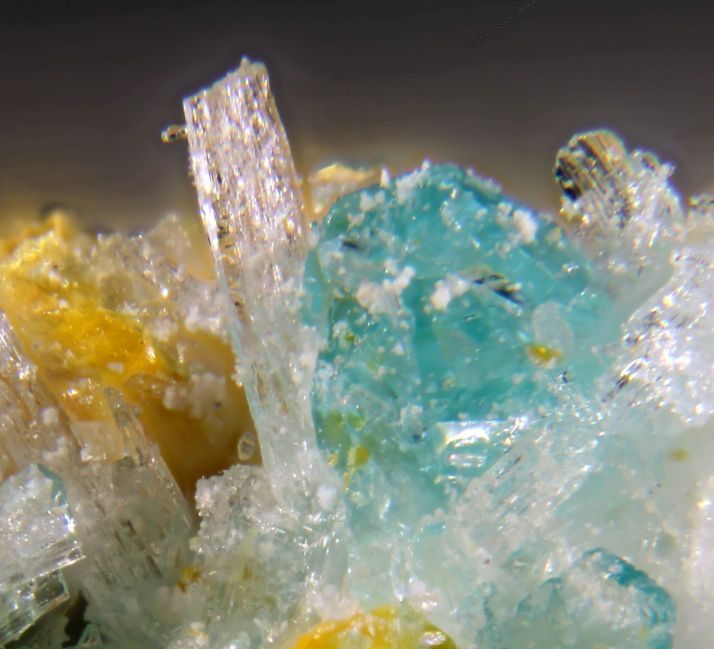
Outsanding tabular colorless crystals of the extremely rare antofagastaite (IMA 2018-049) from the type locality in Chile (Coronel Manuel Rodríguez Mine, Mejillones Peninsula, Antofagasta Province, Antofagasta Region, Chile) and only one of the two known localities worldwide. Associated mineral are yellow sideronatrite and blue green kröhnkite. Part of the holotype specimen. — Photo: David Hospital · CC BY-SA 4.0
Antofagastaite
Antofagastaite is an IMA-recognized mineral species in the sulfate class, with the chemical formula Na₂Ca(SO₄)₂·1.5H₂O.
It crystallizes in the monoclinic crystal system (space group P2_1/m). It is a member of the Syngenite structural group.
Key properties: Mohs hardness 3; specific gravity 2.42; White streak; Vitreous luster; optically biaxial.
IMA symbol Atf, IMA status: approved, named in 2018.
Found in the oxidation zone of sulfide-quartz veins weathered in an extremely arid climate. A sublimate at an active volcanic fumarole.
It is found associated with Sideronatrite, metasideronatrite, aubertite, gypsum, ferrinatrite, glauberite, amarillite (Chile); syngenite, blödite (Russia).
The name refers to the Antofagasta Province, Chile in which the type locality occurs.