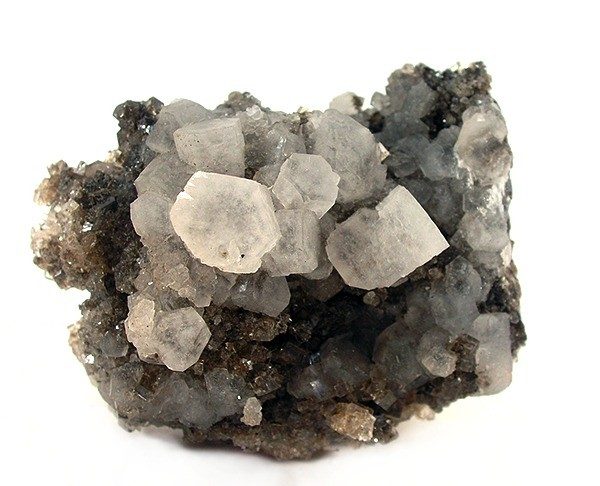
Aphthitalite Locality: Ghom Salt Dome, Qom (Ghom) Province , Iran ( Locality at mindat.org ) Size: 6.1 x 5 x 3 cm. A very rare sulfate, that is apparently stable, and comes at a surprising quality level form these vast salt deposits in Iran. This piece has numerous crystals to over 1 cm. Ex. Martin Zinn Collection. — Photo: Robert M. Lavinsky · CC BY-SA 3.0
Aphthitalite
A potassium-sodium sulfate first described from Mount Vesuvius in 1835; its Greek name means 'unalterable salt' because it resists weathering in air.
Intro adapted from Wikipedia (CC BY-SA).
Aphthitalite is an IMA-recognized mineral species in the sulfate class, with the chemical formula K₃Na(SO₄)₂.
It crystallizes in the hexagonal crystal system (space group P-3m1). It is a member of the Aphthitalite structural group.
Key properties: Mohs hardness 3; specific gravity 2.66–2.71; Vitreous to resinous luster; refractive index 1.492; optically uniaxial.
IMA symbol Att, grandfathered status — known before the IMA’s founding, named in 1813.
An uncommon incrustation around volcanic fumaroles; a component of evaporite deposits; in guano deposits, then typically ammonian.
It is found associated with Thénardite, jarosite, sylvite, hematite (fumaroles); blödite, syngenite, mirabilite, picromerite, borax, halite (evaporites); syngenite, whitlockite, monetite.
Its name comes from the Greek for unalterable and salt, in allusion to its stability in air.