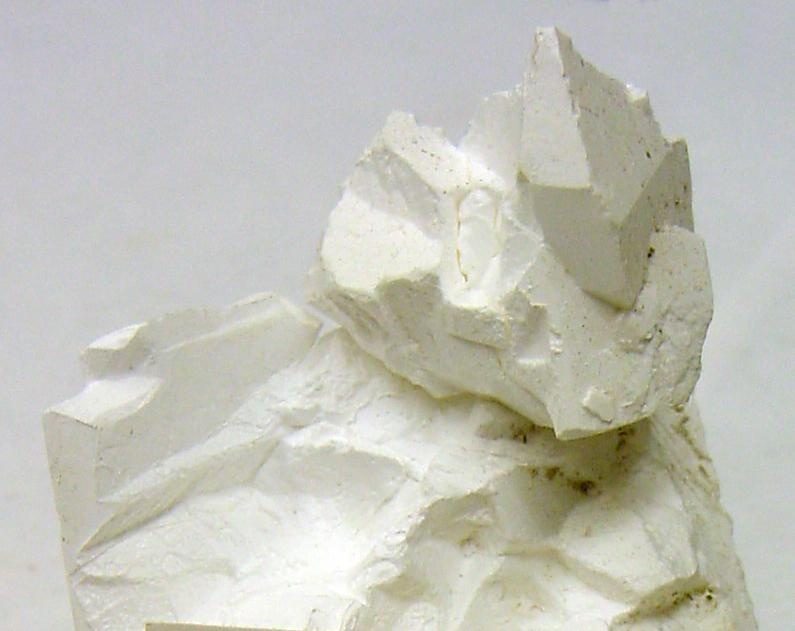
Arcanite Close view. Mineral collection of Brigham Young University Department of Geology, Provo, Utah. Photograph by Andrew Silver. BYU index 10-7018. — Photo: Andrew Silver · Public domain
Arcanite
Arcanite is a potassium sulfate mineral with formula K2SO4. Arcanite was first described in 1845 for an occurrence in old pine railroad ties in the Santa Ana tin mine, Trabuco Canyon, Santa Ana Mountains, Orange County, California, US. It has also been reported from hydrothermal deposits in the Cesano geothermal field, Latium, Italy; in bat guano on the Chincha Islands of Peru; and in caves in Western Australia, South Africa and Namibia.
Intro adapted from Wikipedia (CC BY-SA).
Arcanite is an IMA-recognized mineral species in the sulfate class, with the chemical formula K₂(SO₄).
It crystallizes in the orthorhombic crystal system (space group Pnam). It is a member of the Arcanite structural group.
Key properties: Mohs hardness 2; specific gravity 2.66; refractive index 1.495; optically biaxial.
IMA symbol Acn, grandfathered status — known before the IMA’s founding, named in 1845.
Found in a pine railroad tie (Santa Ana mine, California, USA); in hydrothermally altered rock in a geothermal field (Cesano geothermal field, Italy); derived from bird guano on islands and bat guano in caves.
It is found associated with Syngenite (Cesano geothermal field, Italy); swaknoite, mundrabillaite, dittmarite (Arnhem Cave, Namibia).
The name comes from the Latin arcanum duplicatum, for double secret, a medieval alchemical name.