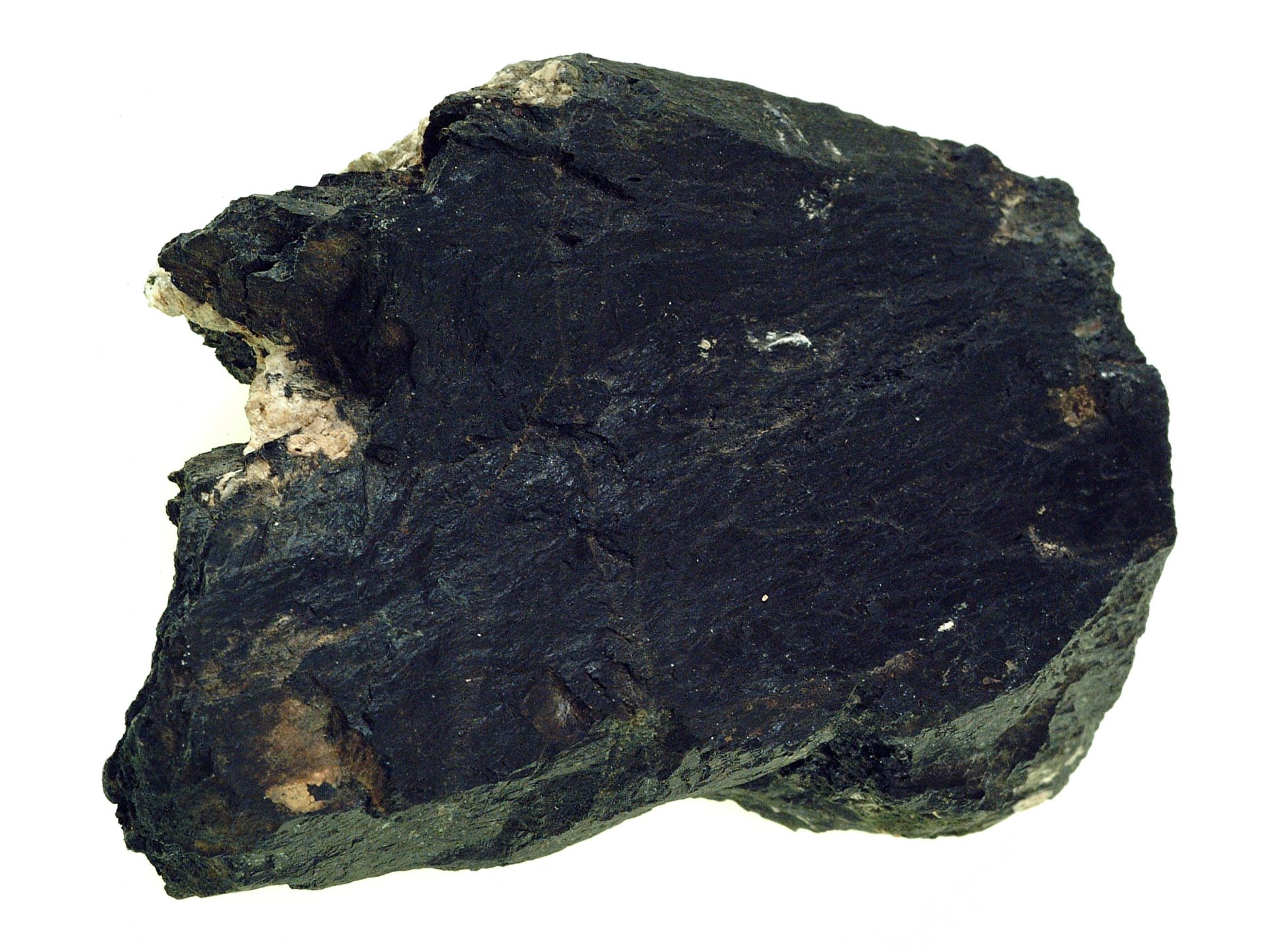
Arfvedsonite is a member of the amphibole group and is also a silicate. It has the mineral formula of Na3(Fe,Mg)4FeSi8O22(OH)2. Arfvedsonite is named for the Swedish chemist, Johan A. Arfvedson. Arfvedsonite is a not so common mineral. This sample is approximately 11 cm across. — Photo: Shannon Heinle · CC0
Arfvedsonite
Arfvedsonite () or soda hornblende (partiellement obsolète) is a sodium amphibole mineral with composition: [Na][Na2][(Fe2+)4Fe3+][(OH)2|Si8O22]. It crystallizes in the monoclinic prismatic crystal system and typically occurs as greenish black to bluish grey fibrous to radiating or stellate prisms. It is a rather rare mineral occurring in nepheline syenite intrusions and agpaitic (peralkaline) pegmatites and granites as the Golden Horn batholith in Okanogan County, Washington (type locality for zektzerite).
Intro adapted from Wikipedia (CC BY-SA).
Arfvedsonite is an IMA-recognized mineral species in the silicate class, with the chemical formula NaNa₂(Fe²⁺₄Fe³⁺)Si₈O₂₂(OH)₂.
It crystallizes in the monoclinic crystal system (space group C2/m). It is a member of the Amphibole structural group.
Key properties: Mohs hardness 5–6; specific gravity 3.3–3.5; Deep bluish gray, gray-green streak; Vitreous luster; refractive index 1.682; optically biaxial.
IMA symbol Arf, IMA status: approved, named in 1823.
Common in alkalic granites and other alkalic plutonic rocks and pegmatites.
It is found associated with Nepheline, albite, aegirine, riebeckite, katophorite, magnesio-katophorite, quartz.
The mineral was named to honor the Swedish chemist, Johan A. Arfvedson (1792–1841). All rights reserved. No part of this publication may be reproduced.