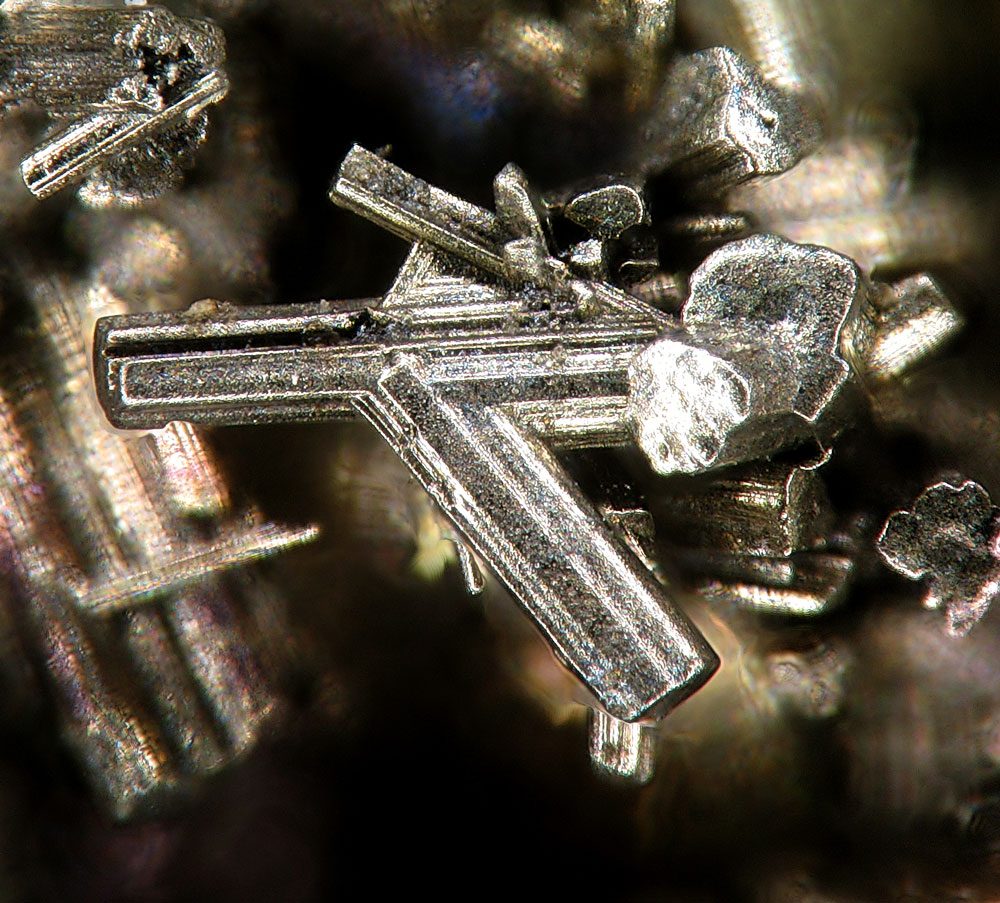
Argentopyrite (Picture width 2 mm) Locality: Schneeberg District, Erzgebirge, Saxony, Germany — Photo: Christian Rewitzer · CC BY-SA 3.0 de
Argentopyrite
Argentopyrite is a moderately rare sulfide mineral with the chemical formula AgFe2S3. It is one of the natural compounds of the MFe2S3 type, with M being caesium in very rare pautovite, copper in relatively common cubanite, potassium in rare rasvumite and thallium in rare picotpaulite. The type locality is Jáchymov in Czech Republic. Chemically similar mineral include sternbergite (dimorphous with argentopyrite), lenaite, AgFeS2, and argentopentlandite, Ag(Fe,Ni)8S8.
Intro adapted from Wikipedia (CC BY-SA).
Argentopyrite is an IMA-recognized mineral species in the sulfide class, with the chemical formula AgFe₂S₃.
It crystallizes in the monoclinic crystal system (space group P2_1/n). It is a member of the Cubanite structural group.
Key properties: Mohs hardness 3.5–4; specific gravity 4.25; Metallic. Anisotropism: Strong, deep blue to pale blue-gray. R1-R2: (400) 20.5-29.4, (420) 21.6-30.2, (440) 22.7-30.8 luster.
IMA symbol Agpy, grandfathered status — known before the IMA’s founding, named in 1866.
Rare in silver-bearing hydrothermal veins.
It is found associated with Arsenic, proustite, pyrargyrite, pyrostilpnite, xanthoconite, sternbergite, stephanite, pyrite, nickel-skutterudite, dolomite, calcite, quartz.
Prefix, argento, for its essential silver content and physical similarity to pyrite.