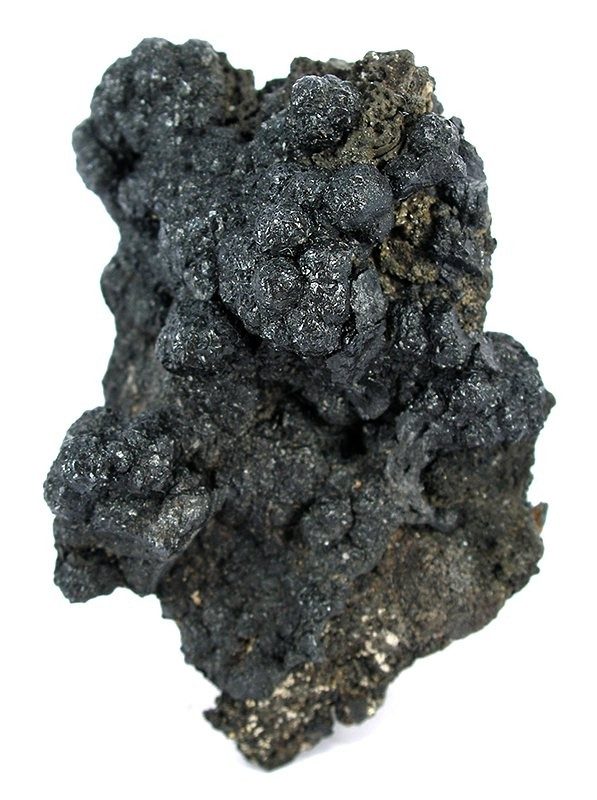
Argyrodite Locality: Himmelsfürst Mine, Brand-Erbisdorf , Freiberg District, Erzgebirge , Saxony , Germany ( Locality at mindat.org ) Size: 4.9 x 3.2 x 2.3 cm. Argyrodite is one of the rarest collectible silver species to obtain in a good display specimen. Argyrodite is an extremely rare GERMANIUM-containing silver sulfide and occurs at its best from this type locality (late 1800s) and from Bolivia as well (same era, into the early 1900s). Year of Discovery: 1886 at this, the type locality. This particular specimen is actually "beautiful" as far as they go, because it has some 3-dimensionality and can be displayed to show dramatically the clusters of 3-4mm Argyrodite crystals atop. They rest on a matrix of pyrite and silver ore. VERY fine display miniature! From the miniature rarities suite of Lawrence Conklin. — Photo: Robert M. Lavinsky · CC BY-SA 3.0
Argyrodite
An uncommon silver-germanium sulfide with a steely black color — historically important as the ore from which Winkler isolated germanium in 1886.
Intro adapted from Wikipedia (CC BY-SA).
Argyrodite is an IMA-recognized mineral species in the sulfide class, with the chemical formula Ag₈GeS₆.
It crystallizes in the orthorhombic crystal system (space group Pna2_1). It is a member of the Argyrodite structural group.
Key properties: Mohs hardness 2.5–3; specific gravity 6.29; Gray-black streak; Strong metallic luster.
IMA symbol Agy, grandfathered status — known before the IMA’s founding, named in 1886.
Found in low-temperature polymetallic deposits with silver sulfosalts (Freiberg, Germany); in high-temperature Sn–Ag deposits (Bolivia).
It is found associated with Canfieldite, stephanite, acanthite, pyrargyrite, polybasite, aramayoite, diaphorite, marcasite, pyrite, galena, sphalerite, cassiterite, siderite.
Its name comes from the Greek for silver-containing.