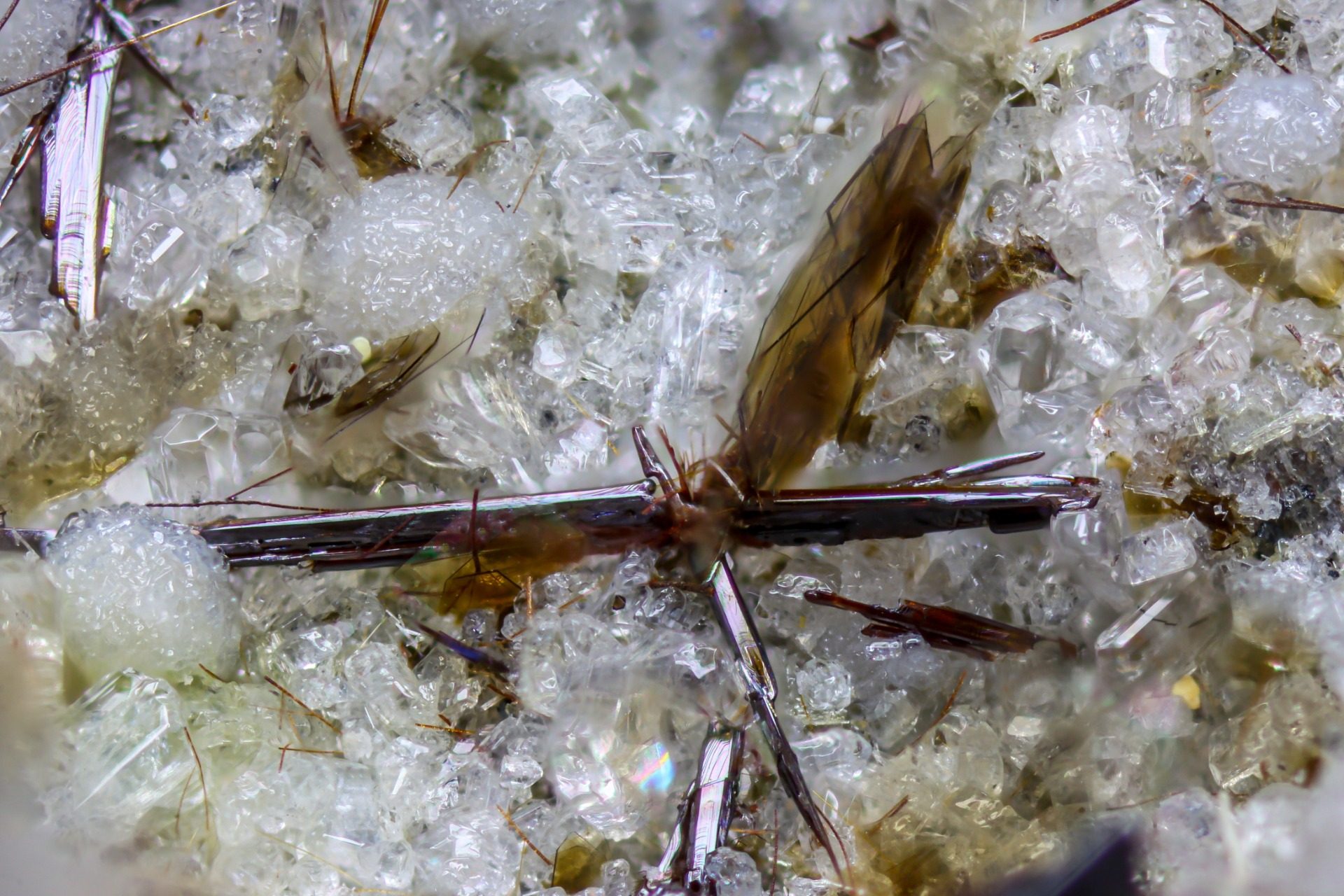
Armalcolite and phlogopite Field of view: 1.5 mm Locality: La Aljorra Quarries, Cartagena, Murcia, Spain — Photo: Henk Smeets – tomeikminerals.com · CC BY 4.0
Armalcolite
A titanium-rich mineral first found in Moon rocks brought back by Apollo 11 — named by combining Armstrong, Aldrin and Collins.
Intro adapted from Wikipedia (CC BY-SA).
Armalcolite is an IMA-recognized mineral species in the oxides & hydroxide class, with the chemical formula (Mg,Fe²⁺)Ti₂O₅.
It crystallizes in the orthorhombic crystal system (space group Bbmm). It is a member of the Pseudobrookite structural group.
Key properties: Mohs hardness 5; specific gravity 4.94; Metallic luster; optically biaxial.
IMA symbol Arm, IMA status: approved, named in 1970.
Formed typically at low pressures and high temperatures; in Ti-rich basalts and microbreccias of lunar samples; in salic volcanics; rarely in granite pegmatite; in ultramafic rocks, lamproites, kimberlites; in terrestrial impact craters.
It is found associated with Ilmenite, Fe–Ti oxides, iron, graphite (Disko Island, Greenland); phlogopite, analcime, diopside (Smoky Butte, Montana, USA); rutile, ilmenite (Kimberley.
An acronym derived from the last names of Neil Alden ARMstrong (1930–), Edwin Eugene ALdrin (1930–), and Michael COLlins (1930–), the Apollo XI astronauts who collected the type samples.