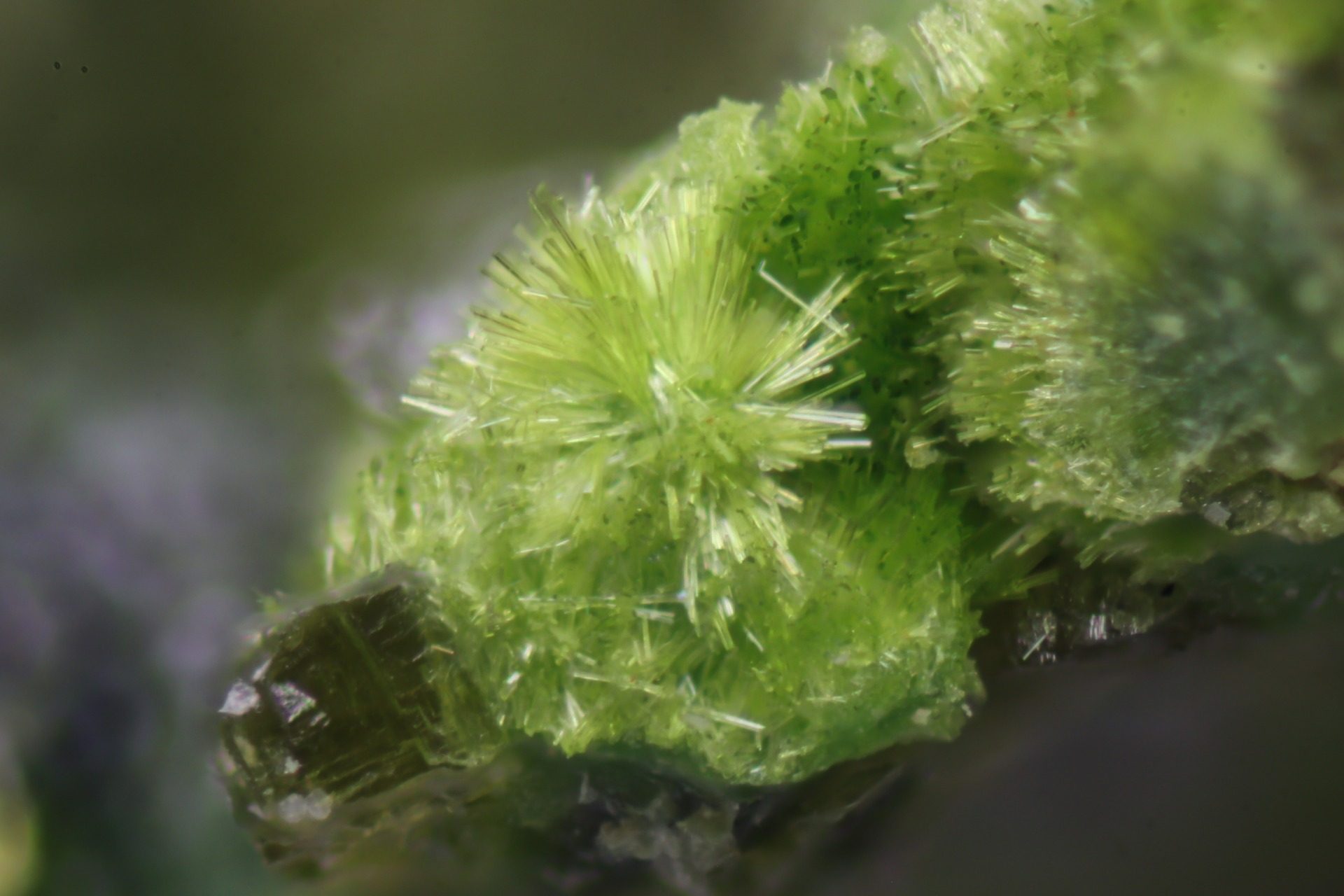
Arthurite Field of view: 1 mm Locality: Majuba Hill, Pershing County, Nevada, USA — Photo: Henk Smeets – tomeikminerals.com · CC BY 4.0
Arthurite
A copper-iron mineral mixing arsenate, phosphate and sulfate, discovered in 1954 at a Cornish copper mine by Sir Arthur Russell.
Intro adapted from Wikipedia (CC BY-SA).
Arthurite is an IMA-recognized mineral species in the arsenate class, with the chemical formula CuFe³⁺₂(AsO₄)₂(OH)₂·4H₂O.
It crystallizes in the monoclinic crystal system (space group P2_1/c). It is a member of the Arthurite structural group.
Key properties: Mohs hardness 3.5; specific gravity 3.2; optically biaxial.
IMA symbol Atu, IMA status: approved, named in 1964.
A rare secondary mineral found in the oxidized zone of some copper deposits, produced through alteration of arsenopyrite or enargite.
It is found associated with Pharmacosiderite, scorodite, conichalcite, chenevixite, chalcophyllite, brochantite, quartz.
The mineral was named to honor Sir Arthur Edward Ian Montagu Russell (1878–1964) and Arthur William Gerald Kingsbury (1906–1968) for their substantial contributions to British mineralogy.