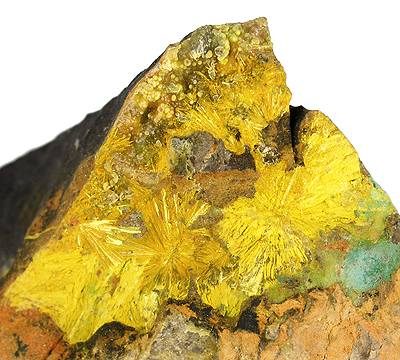
Astrocyanite-(Ce) , Kamotoite-(Y) , Uraninite , Uranophane - alpha Locality: Kamoto East Open cut, Kamoto, Kolwezi , Western area, Katanga Copper Crescent, Katanga (Shaba) , Democratic Republic of Congo (Zaïre) ( Locality at mindat.org ) Size: miniature, 5.8 x 4.7 x 3.8 cm Kamotoite and Astrocyanite with Uranophane on Uraninite TYPE LOCALITY material of these VERY rare species! The kamotoite are the vibrant yellow crystalline sprays with individual flat-laying crystals to 6 or 7 mm, accented by microcrystalline uranophane around their periphery and by a small bit of subcrystalline Astrocyanite (blue). Aesthetic, rich specimen, of some significance. TYPE LOCALITY for both Kamotoite and Astrocyanite — Photo: Robert M. Lavinsky · CC BY-SA 3.0
Astrocyanite-(Ce)
Astrocyanite-(Ce) is a bright blue mineral with the chemical formula Cu2(Ce,Nd,La)2(UO2)(CO3)5(OH)2·1.5H2O. Its type locality is Kamoto East Open Cut, Kamoto, Kolwezi, Lualaba, Congo The name of this mineral comes from the Ancient Greek: άστρον ("astron") for "star", κυανός ("kyanos") for "blue", in allusion to its colour and habit of the aggregates, and the dominant lanthanide element in its composition.
Intro adapted from Wikipedia (CC BY-SA).
Astrocyanite-(Ce) is an IMA-recognized mineral species in the carbonate class, with the chemical formula Cu₂Ce₂(UO₂)(CO₃)₅(OH)₂·1.5H₂O.
It crystallizes in the hexagonal crystal system.
Key properties: Mohs hardness 2–3; specific gravity 3.8; Vitreous luster; optically uniaxial.
IMA symbol Acy-Ce, IMA status: approved, named in 1989.
Found in the oxidation zone of the uranium-bearing portion of a Cu–Co deposit.
It is found associated with Uraninite, uranophane, kamotoite-(Y), françoisite-(Nd), shabaite-(Nd), schuilingite-(Nd), masuyite.
Its name comes from the Greek astro and kyanos, alluding to the starlike habit and blue color, and for cerium as the dominant rare-earth element.