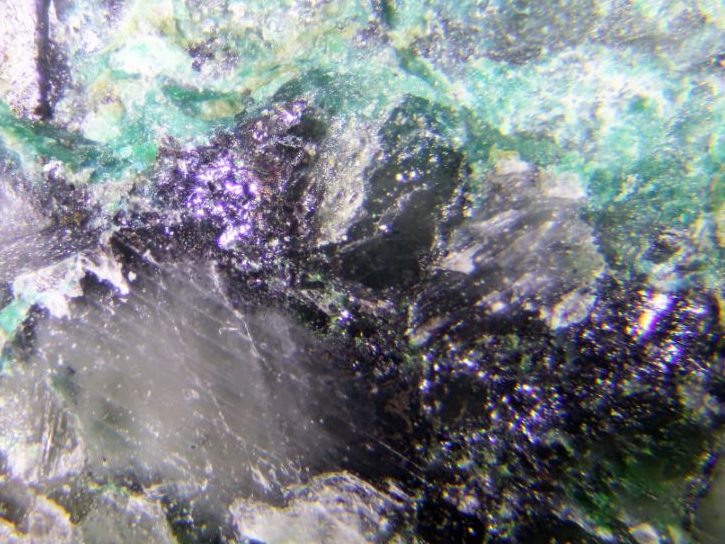
Metallic crystal aggregates of the rare Cu-selenide mineral athabascaite from Sierra de Umango, Villa Castelli, General Lamadrid Department, La Rioja, Argentina. Ex Vandenbroucke Museum collection from Waregem, Belgium. — Photo: David Hospital · CC BY-SA 4.0
Athabascaite
A copper selenide discovered in 1949 by S. Kaiman during uranium exploration around Lake Athabasca.
Intro adapted from Wikipedia (CC BY-SA).
Athabascaite is an IMA-recognized mineral species in the sulfide class, with the chemical formula Cu₅Se₄.
It crystallizes in the orthorhombic crystal system.
Key properties: specific gravity 6.59; Metallic luster.
IMA symbol Atb, IMA status: approved, named in 1969.
Occurs as inclusions in and replacements of umangite, as stringers and veinlets in carbonate veins cutting basalt (Martin Lake mine, Canada).
It is found associated with Umangite, clausthalite, eucairite, berzelianite, sulfatian berzelianite, klockmannite, eskebornite, tyrrellite, copper, silver, uraninite, hematite, pyrite.
The name refers to Lake Athabasca, northern Saskatchewan, Canada.