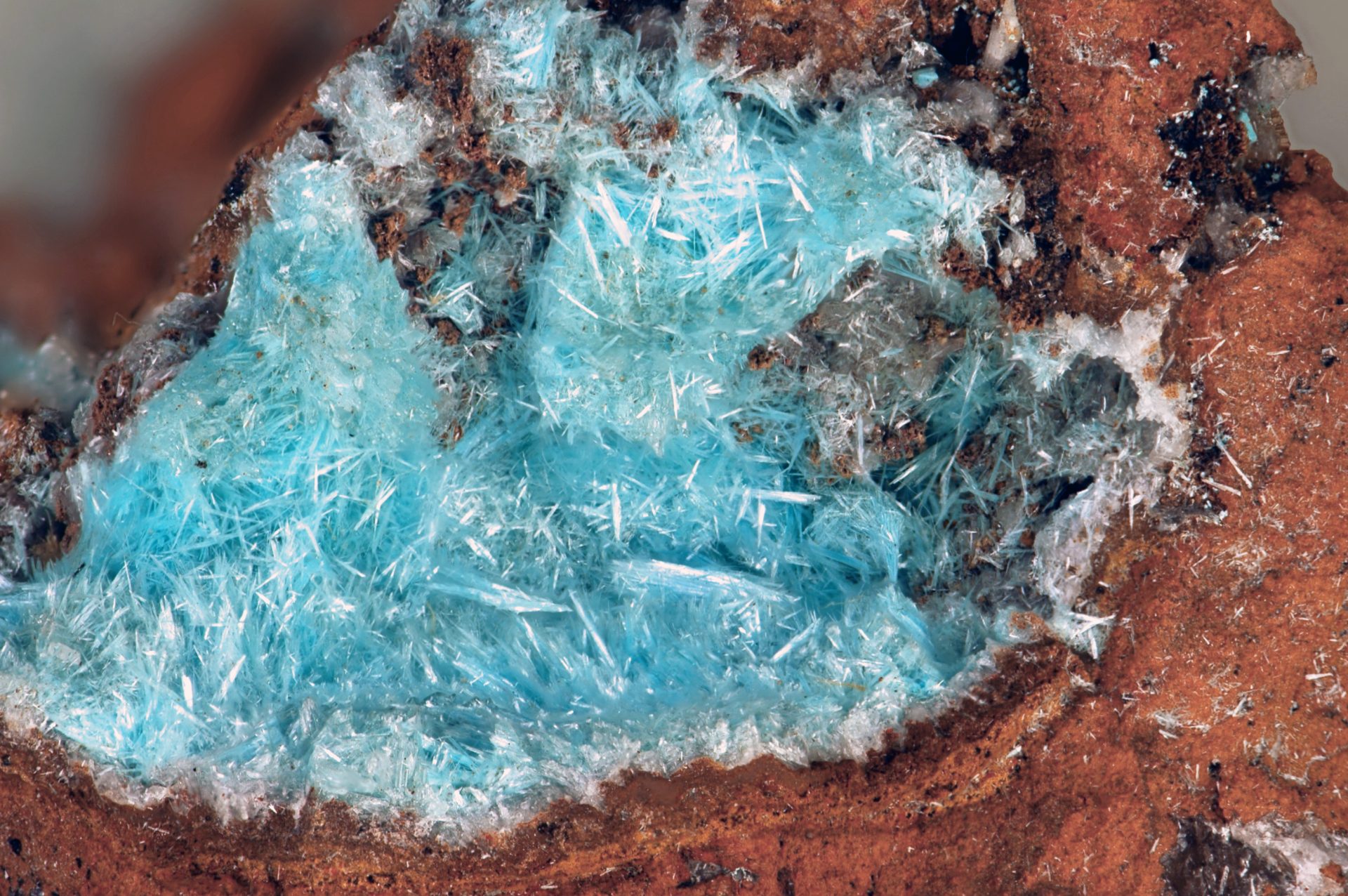
A mineral is a naturally-occurring, solid, inorganic, crystalline substance having a fairly definite chemical composition and having fairly definite physical properties. At its simplest, a mineral is a naturally-occurring solid chemical. Currently, there are over 5900 named and described minerals - about 200 of them are common and about 20 of them are very common. Mineral classification is based on anion chemistry. Major categories of minerals are: elements, sulfides, oxides, halides, carbonates, sulfates, phosphates, and silicates. The carbonate minerals all contain one or more carbonate (CO3-2) anions. Aurichalcite is a scarce zinc copper hydroxycarbonate mineral ((Zn,Cu)5(CO3)2(OH)6). It has a nonmetallic luster, a robin's egg blue color, and tends to form small, delicate needle-like crystals. The rock seen here is iron hydroxy-oxide gossan having a vug of pale bluish aurichalcite needles. It comes from an oxidized carbonate replacement deposit in Mexico's Ojuela Mine. Locality: Ojuela Mine, Mapimí, northeastern Durango State, northern Mexico Photo gallery of aurichalcite: www.mindat.org/gallery.php?min=422 — Photo: James St. John · CC BY 2.0
Aurichalcite
A soft green-blue zinc-copper carbonate that forms in the oxidized zones of copper and zinc deposits.
Intro adapted from Wikipedia (CC BY-SA).
Aurichalcite is an IMA-recognized mineral species in the carbonate class, with the chemical formula (Zn,Cu)₅(CO₃)₂(OH)₆.
It crystallizes in the monoclinic crystal system (space group P2_1/m).
Key properties: Mohs hardness 1–2; specific gravity 3.96; Silky to pearly luster; refractive index 1.713; optically biaxial.
IMA symbol Ach, grandfathered status — known before the IMA’s founding, named in 1839.
Found in the oxidized zones of copper and zinc deposits.
It is found associated with Rosasite, smithsonite, hemimorphite, hydrozincite, malachite, azurite.
The name comes from the Latin for golden copper, brass, for the copper and zinc content of the mineral.