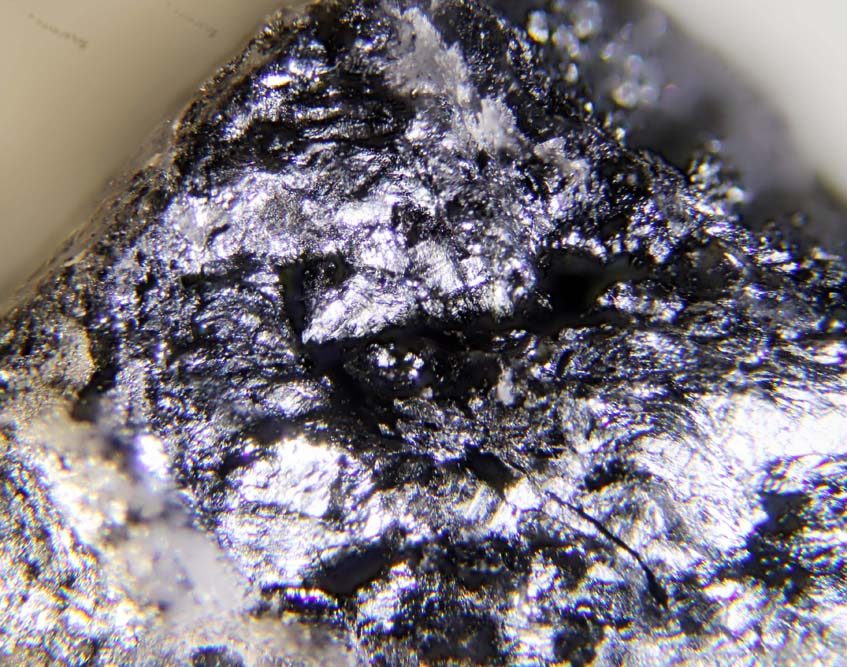
Aurostibite is a rare mineral of simple chemistry, since it is a gold antimonide, AuSb2. It occurs in this specimen as silvery crystal aggregates scattered on the specimen. From: Krásná Hora Nad Vltavou, Bohemia, Czech Republic. — Photo: David Hospital · CC BY-SA 4.0
Aurostibite
Aurostibite is an isometric gold antimonide mineral which is a member of the pyrite group. Aurostibite was discovered in 1952 and can be found in hydrothermal gold-quartz veins, in sulfur-deficient environments that contain other antimony minerals. The mineral can be found in Yellowknife in the Northwest Territories of Canada, and the Timiskaming District in Ontario, Canada. Antimonides are rare and are normally placed in the sulfide class by mineralogists.
Intro adapted from Wikipedia (CC BY-SA).
Aurostibite is an IMA-recognized mineral species in the sulfide class, with the chemical formula AuSb₂.
It crystallizes in the cubic crystal system (space group Pa3). It is a member of the Pyrite structural group.
Key properties: Mohs hardness 3; specific gravity 9.98; Metallic. R: (400) 56.4, (420) 57.2, (440) 57.9, (460) 58.6, (480) 59.1, (500) 59.6, (520) 60.0, (540) 60.3 luster.
IMA symbol Ausb, grandfathered status — known before the IMA’s founding, named in 1952.
Found in hydrothermal gold-quartz veins, in portions deficient in sulfur and containing other antimony minerals.
It is found associated with Gold, freibergite, stibnite, jamesonite, chalcostibite, bournonite, boulangerite, arsenopyrite, pyrite, chalcopyrite, sphalerite, galena, tetrahedrite.
In reference to its composition.