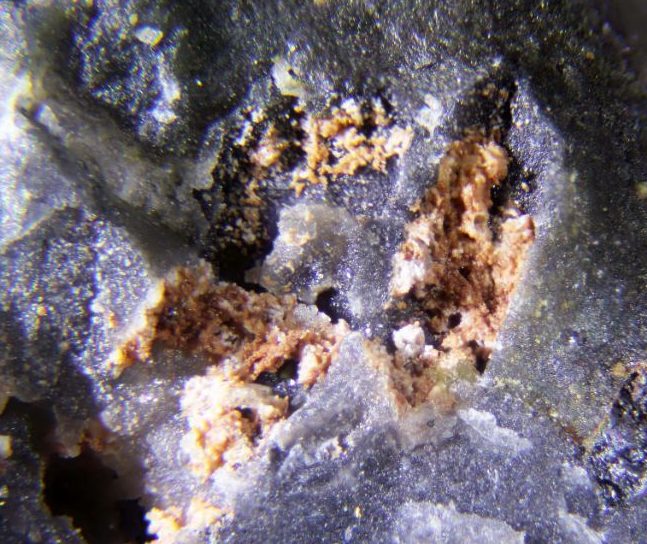
Yellow brown aggregates of the mineral avicennite associated to parapierrotite. From Lookout Pass, Little Valley, Tooele County, Utah, United States of America. Ex Vandenbroucke Museum collection from Waregem, Belgium. — Photo: David Hospital · CC BY 4.0
Avicennite
Avicennite (thallium(III) oxide) is an oxide mineral. It was discovered around the Dzhuzumli village, Samarqand, Uzbekistan. It is named after Avicenna, a Persian doctor and polymath.
Intro adapted from Wikipedia (CC BY-SA).
Avicennite is an IMA-recognized mineral species in the oxides & hydroxide class, with the chemical formula Tl₂O₃.
It crystallizes in the cubic crystal system (space group I2_13). It is a member of the Bixbyite structural group.
Key properties: Mohs hardness 1.5–2.5; specific gravity 8.9; Grayish black, black with a brownish tint streak; Metallic luster.
IMA symbol Avc, grandfathered status — known before the IMA’s founding, named in 1958.
Found in the weathered zone of a hematite-calcite vein cutting banded marmorized and silicified limestones near a granite-gneiss contact (near Dzhuzumli, Tajikistan).
It is found associated with Hematite, “limonite”, ferruginous clay minerals (near Dzhuzumli, Tajikistan); carlinite, hematite, quartz (Carlin mine, Nevada, USA).
The name refers to the medieval Uzbek (Persian) scholar and physician, Abū ‘Alı̄ al-Husayn ibn ‘Abd Allāh ibn Sı̄nā (Avicenna) (930–1037), who lived in Bukhara, Tajikistan.