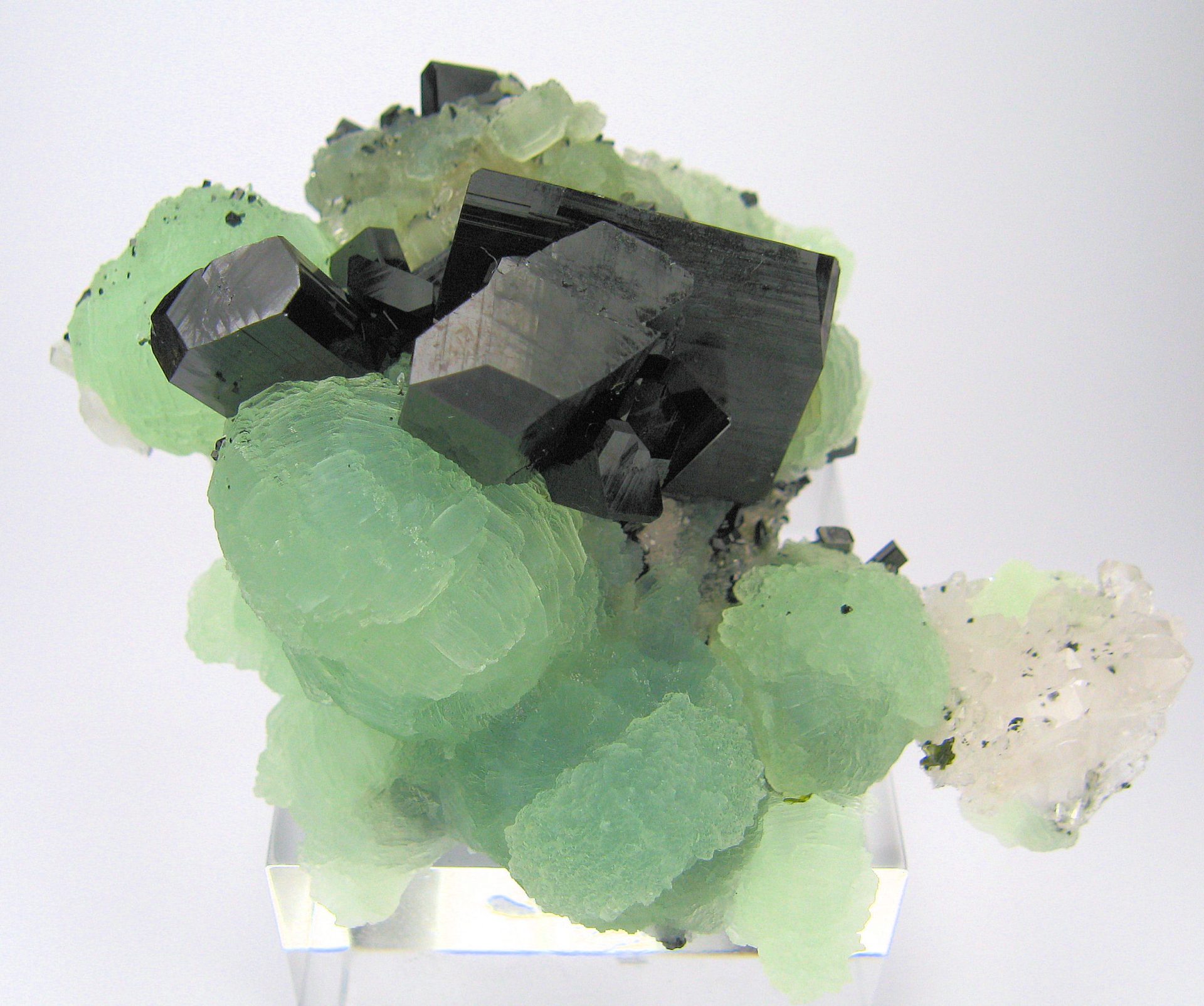
Triclinic crystals of babingtonite with prehnite, from Qiaojia, Qiaojia Co., Zhaotong, Yunnan, China (size: 71 mm x 55 mm, 71 g) — Photo: CarlesMillan · CC BY-SA 3.0
Babingtonite
A calcium-iron-manganese silicate unusual because ferric iron completely takes the place normally held by aluminium.
Intro adapted from Wikipedia (CC BY-SA).
Babingtonite is an IMA-recognized mineral species in the silicate class, with the chemical formula Ca₂Fe²⁺Fe³⁺Si₅O₁₄(OH).
It crystallizes in the triclinic crystal system (space group P-1). It is a member of the Rhodonite structural group.
Key properties: Mohs hardness 5.5–6; specific gravity 3.34–3.37; Vitreous luster; refractive index 1.712; optically biaxial.
IMA symbol Bab, grandfathered status — known before the IMA’s founding, named in 1824.
Found in veins cutting granite pegmatite and diorite; in cavities and vugs in mafic volcanic rocks and gneisses; in skarns.
It is found associated with Prehnite, calcite, epidote, albite, orthoclase, garnet, quartz, \hornblende, " zeolites.
The name refers to Dr. William Babington (1756–1833), Irish physician and mineralogist. All rights reserved. No part of this publication may be reproduced.