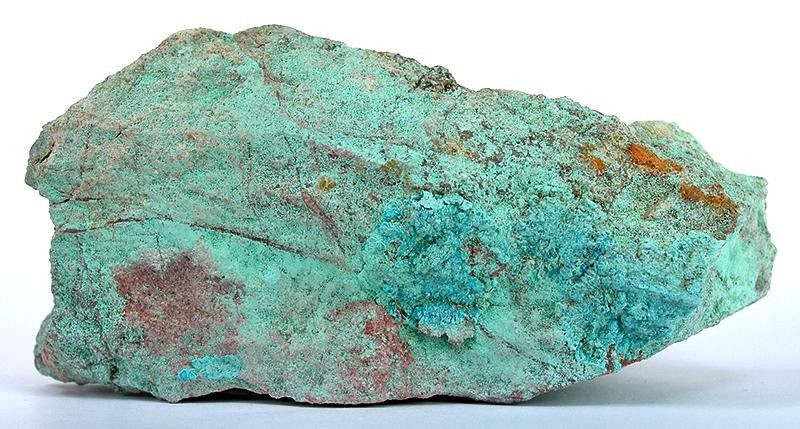
Bandylite Locality: Queténa Mine, Toki Cu deposit, Chuquicamata District, Calama , El Loa Province , Antofagasta Region , Chile ( Locality at mindat.org ) Size: 11.9 x 7.0 x 5.0 cm. This matrix, stained by multi-colored copper hues, is host to two dark green patches of finely microcrystallized bandylite, a rare copper, boron, hydroxide, chloride. Note also the patches of lighter blue to the right side of the specimen as shown atop: The larger area of bandylite measures over 2.0 cm across. Ex. Philadelphia Academy of Natural Sciences. — Photo: Robert M. Lavinsky · CC BY-SA 3.0
Bandylite
Bandylite is an IMA-recognized mineral species in the halide class, with the chemical formula CuB(OH)₄Cl.
It crystallizes in the tetragonal crystal system (space group P4/nmm).
Key properties: Mohs hardness 2.5; specific gravity 2.81; Pale blue streak; Vitreous, pearly on cleavage surfaces; dull when altered luster; optically uniaxial.
IMA symbol Bny, grandfathered status — known before the IMA’s founding, named in 1938.
Of secondary origin, in a leached zone above massive iron sulfates (Quetena, Chile).
It is found associated with Atacamite, eriochalcite (Quetena, Chile); starkeyite (near Taltal, Chile).
The name refers to Dr. Mark Chance Bandy (1900–1963), American mining engineer, mineralogist, and mineral collector, who first collected the mineral.