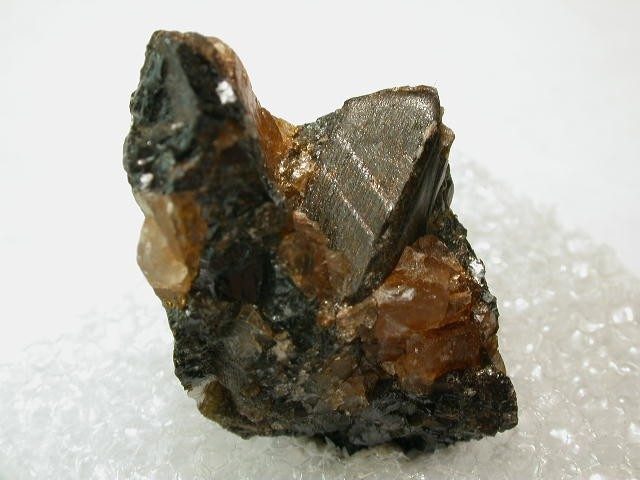
Bannisterite , Bustamit Locality: North Mine (North Broken Hill Mine; NBH Mine), Broken Hill, Yancowinna County, New South Wales, Australia Original description: A 2.5 by 1.7 cms specimen of black crystals with brown Bustamite. — Photo: John Sobolewski (JSS) · CC BY 3.0
Bannisterite
A phyllosilicate chemically similar to tamaite, named for X-ray crystallographer Frederick Bannister.
Intro adapted from Wikipedia (CC BY-SA).
Bannisterite is an IMA-recognized mineral species in the silicate class, with the chemical formula (Ca,K,Na)(Mn²⁺,Fe²⁺)₁₀(Si,Al)₁₆O₃₈(OH)₈·nH₂O.
It crystallizes in the monoclinic crystal system (space group A2/a). It is a member of the Stilpnomelane, Clay structural group.
Key properties: Mohs hardness 4; specific gravity 2.83–2.84; Resinous luster; optically biaxial.
IMA symbol Ban, IMA status: approved, named in 1967.
Found in metamorphosed Mn-Zn orebodies.
It is found associated with Manganoan and zincian amphiboles, rhodonite, sphalerite, quartz, calcite, barite (Franklin, New Jersey, USA); rhodonite, sphalerite, fluorite, galena.
The mineral was named to honor Dr. Frederick Allen Bannister (1901{), formerly Keeper of Minerals, British Museum (Natural History), London, England.