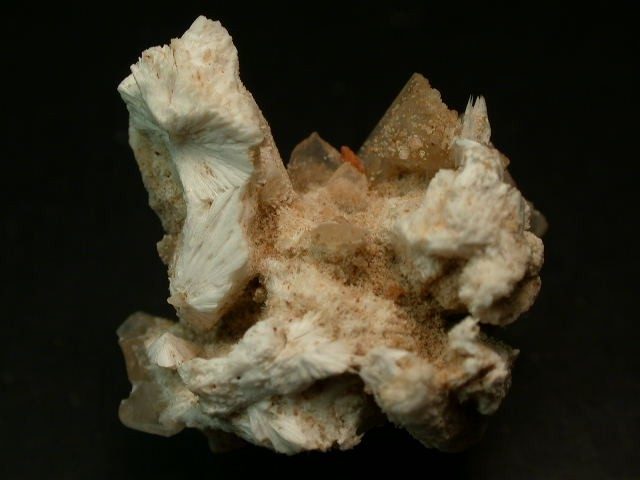
Bassanite Locality: Kimba, Eyre Peninsula, South Australia, Australia Original description: A 3.0 by 2.6 cms white mass with some Gypsum crystals. JSS specimen and photo. — Photo: John Sobolewski (JSS) · CC BY 3.0
Bassanite
Calcium sulfate hemihydrate — half a water molecule per formula unit — first described in 1910 from Mount Vesuvius; the mineral version of plaster of Paris.
Intro adapted from Wikipedia (CC BY-SA).
Bassanite is an IMA-recognized mineral species in the sulfate class, with the chemical formula Ca(SO₄)·0.5H₂O.
It crystallizes in the monoclinic crystal system (space group I2). It is a member of the Rhabdophane structural group.
Key properties: specific gravity 2.69–2.76; refractive index 1.566; optically biaxial.
IMA symbol Bss, grandfathered status — known before the IMA’s founding, named in 1910.
Altered from gypsum in leucite tephrite blocks; fumarolic (Vesuvius, Italy); in dry or perennially dry lake beds (California, Australia); in caves, interlayered with gypsum.
It is found associated with Gypsum, anhydrite, celestine, calcite, gibbsite.
The mineral was named to honor Francesco Bassani (1853–1916), Professor of Paleontology, University of Naples, Naples, Italy.