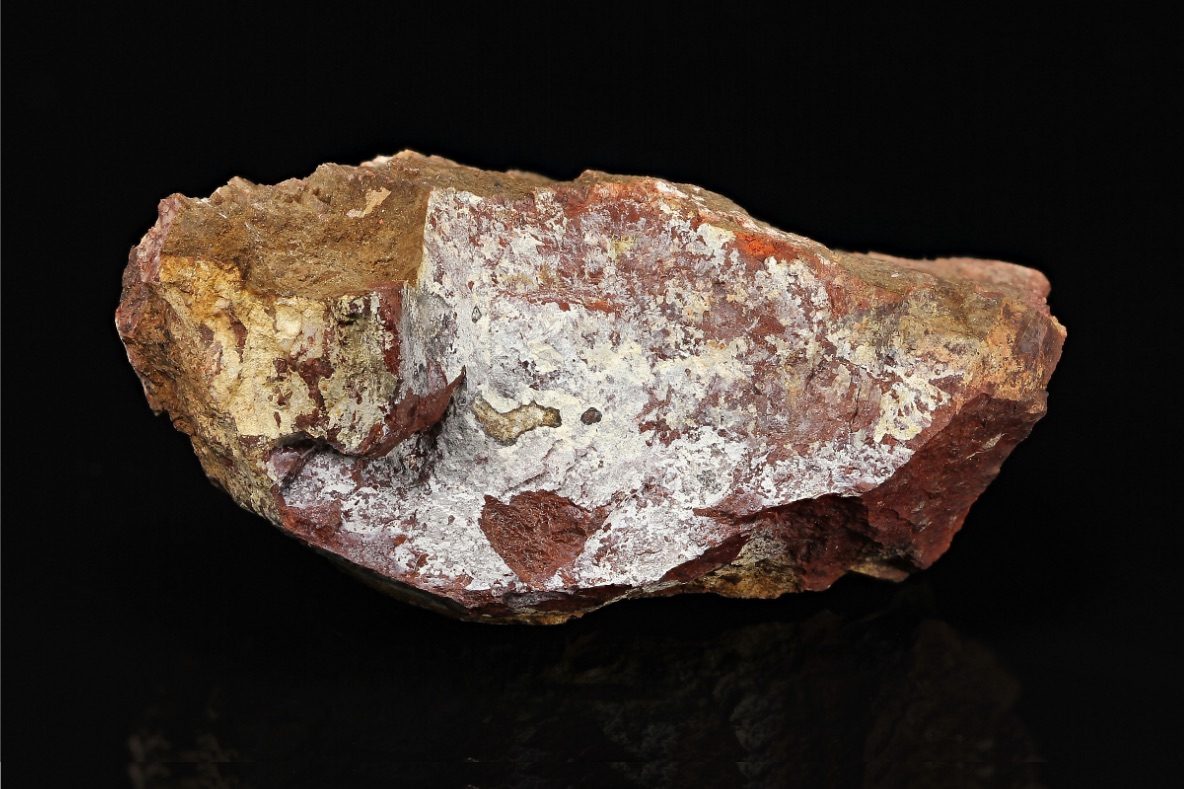
Locality: Pyörönmaa pegmatite, Kangasala, Western and Inner Finland Region, Finland Dimensions: 55 mm x 30 mm x 20 mm Brownish red mixture of bastnäsite-(Y), quartz and hematite. White tengerite-(Y) filling in fissures. Collected 2012. — Photo: Jyrki Autio · CC0
Bastnäsite-(Y)
The mineral bastnäsite (or bastnaesite) is one of a family of three fluorocarbonate minerals, which includes bastnäsite-(Ce) with a formula of (Ce, La)CO3F, bastnäsite-(La) with a formula of (La, Ce)CO3F, and bastnäsite-(Y) with a formula of (Y, Ce)CO3F. Some of the bastnäsites contain OH− instead of F− and receive the name of hydroxylbastnasite. Most bastnäsite is bastnäsite-(Ce), and cerium is by far the most common of the rare earths in this class of minerals. Bastnäsite and the phosphate mineral monazite are the two largest sources of cerium and other rare-earth elements.
Intro adapted from Wikipedia (CC BY-SA).
Bastnäsite-(Y) is an IMA-recognized mineral species in the carbonate class, with the chemical formula Y(CO₃)F.
It crystallizes in the hexagonal crystal system. It is a member of the Bastnäsite structural group.
IMA symbol Bsn-Y, IMA status: approved, named in 1970.