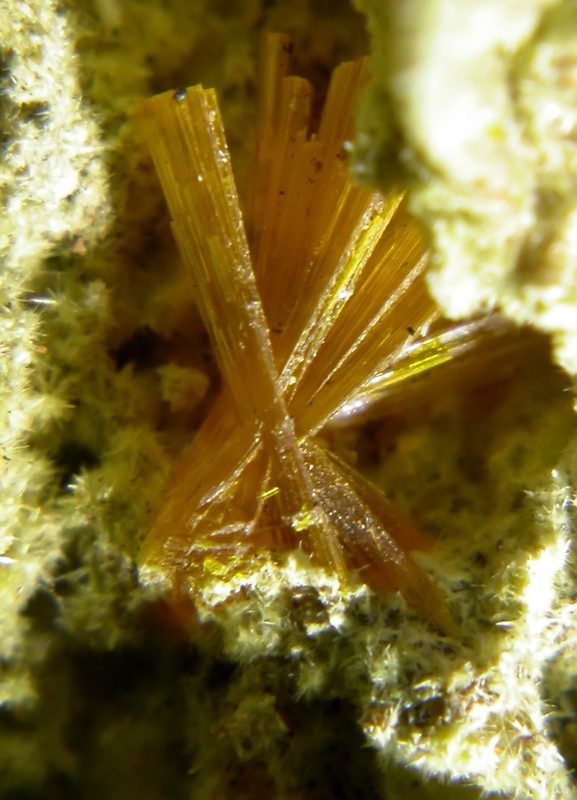
Becquerelite , Uranophane - alpha , Uraninite Locality: Shinkolobwe Mine (Kasolo Mine), Shinkolobwe , Central area, Katanga Copper Crescent, Katanga (Shaba) , Democratic Republic of Congo (Zaïre) ( Locality at mindat.org ) Size: 5 x 4.5 x 2.2 cm. Shinkolobwe is the type locality for Becquerelite where it forms lathe-like, yellow to orange, flat-terminated crystals. Here the mineral is associated with Uranophane in very tiny needles. Sometimes the crystals cluster together like shown in the photo, and they reach on this specimen 5 mm. This is a good reference piece for a locality that is closed since more than 50 years. — Photo: Robert M. Lavinsky · CC BY-SA 3.0
Becquerelite
A bright-yellow calcium uranyl oxide hydrate, named for radioactivity pioneer Henri Becquerel.
Intro adapted from Wikipedia (CC BY-SA).
Becquerelite is an IMA-recognized mineral species in the oxides & hydroxide class, with the chemical formula Ca(UO₂)₆O₄(OH)₆·8H₂O.
It crystallizes in the orthorhombic crystal system (space group Pn2_1a).
Key properties: Mohs hardness 2.5; specific gravity 5.09–5.2; Yellow streak; Adamantine to greasy luster; refractive index 1.793; optically biaxial.
IMA symbol Bqr, grandfathered status — known before the IMA’s founding, named in 1922.
A weathering product of uraninite in the oxidized portions of uranium deposits and, more rarely, in pegmatites.
It is found associated with Uraninite, schoepite, soddyite, curite, fourmarierite, dewindtite, ianthinite, wölsendorfite, rutherfordine, masuyite, kasolite (Shinkolobwe, Congo).
The name refers to French physicist Antoine Henri Becquerel (1852–1908), who discovered radioactivity in 1896.