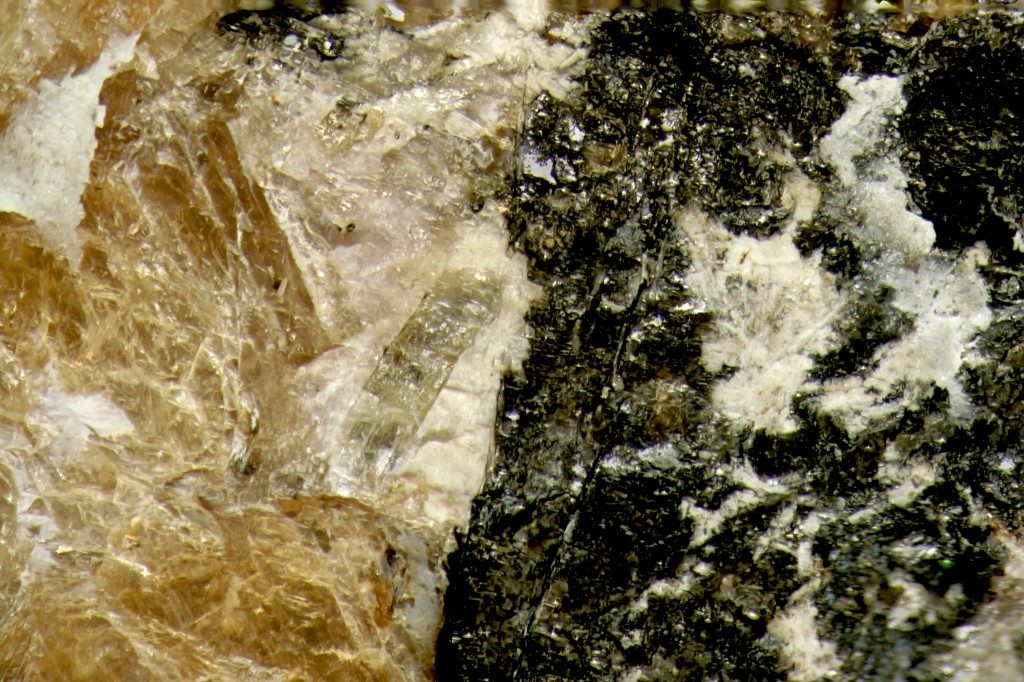
Belovite-(Ce) , Umbozerite , Sérandite , Shkatulkaite (FOV 7.1 x 4.7 mm) Locality: Shkatulka pegmatite, Umbozero mine (Umbozerskii mine), Alluaiv Mt, Lovozero Massif, Kola Peninsula, Murmanskaja Oblast', Northern Region, Russia Description: Orange sérandite (on the left), pink ussingite (top), greenish belovite-(Ce) (center). I see deep REE absorption lines. It’s a bit hard to tell exactly where they are coming from, but I’m fairly sure it is from the greenish xl. Per Pavel's inspection of the photo, he agrees that it is belovite. The xl is about 1¾ mm long. The black stuff (on the right) has a conchoidal fracture and looks a bit like steenstruoine-(Ce, but is is altered umbozerite (as confirmed by Pavel from inspection of the photo.) The white stuff on the umbozerite is probably shkatulkalite. (Pavel did not comment on this.) — Photo: Modris Baum · Public domain
Belovite-(Ce)
Belovite-(Ce) is an IMA-recognized mineral species in the phosphate class, with the chemical formula NaCeSr₃(PO₄)₃F.
It crystallizes in the hexagonal crystal system (space group P-3). It is a member of the Apatite structural group.
Key properties: Mohs hardness 5; specific gravity 4.19; Vitreous, greasy on fracture surfaces luster; optically uniaxial.
IMA symbol Blv-Ce, grandfathered status — known before the IMA’s founding, named in 1954.
Found as a secondary mineral in pegmatites in differentiated alkalic massifs.
It is found associated with Ussingite, natrolite, chkalovite, epistolite, tugtupite, mangan-neptunite, murmanite, gaidonnayite, nordite-(La), lamprophyllite, fluorcaphite, lomonosovite.
The mineral was named to honor Russian crystallographer and academician Nikolai Vasil’evich Belov (1891–1982), former Head of the Crystallography and Crystallochemistry Department.