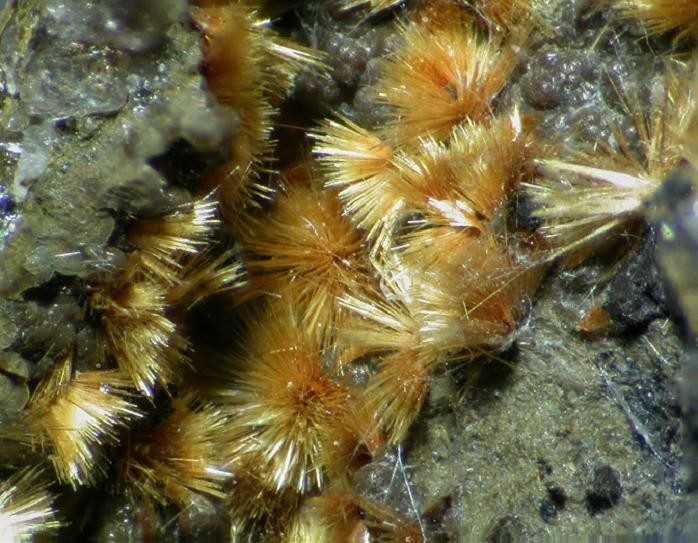
Beraunite Locality: Mark Mine, Essershausen, Weilburg, Wetzlar, Hesse, Germany Field of view 4 mm. Depth of field is achieved with CombineZM. Specimen and photo Leon Hupperichs. — Photo: Leon Hupperichs · CC BY-SA 3.0
Beraunite
An iron phosphate found as a secondary mineral in iron deposits and altered granite pegmatites, first described from Beraun in the Czech Republic.
Intro adapted from Wikipedia (CC BY-SA).
Beraunite is an IMA-recognized mineral species in the phosphate class, with the chemical formula Fe³⁺₆(PO₄)₄O(OH)₄·6H₂O.
It crystallizes in the monoclinic crystal system (space group C2/c). It is a member of the Beraunite structural group.
Key properties: Mohs hardness 3–4; specific gravity 2.8–3.08; Olive-drab when fresh; yellow, brownish yellow on exposure streak; Vitreous, pearly on cleavages, resinous on fractures luster; optically biaxial.
IMA symbol Bru, grandfathered status — known before the IMA’s founding, named in 1841.
A component of bog iron ores; a cement in clays, sands, and bone material; an alteration product of triphylite in granite pegmatites.
It is found associated with Vivianite, dufrénite, rockbridgeite, cacoxenite, wavellite, ferrostrunzite, ferristrunzite, frondelite, huréaulite, mitridatite, stewartite, laueite.
The name refers to its occurrence near Beroun (formerly Beraun), Czech Republic.