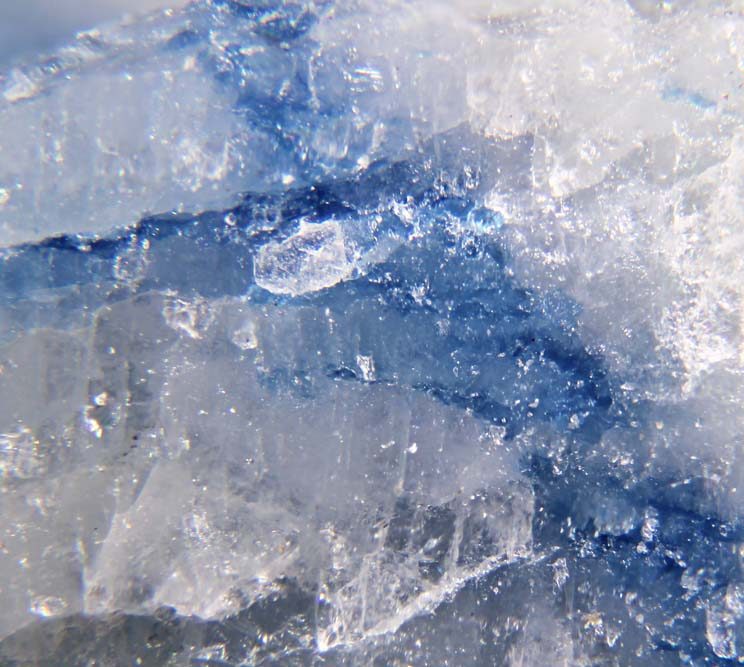
Blue veinlets of the rare mineral berlinite on a white contrasting matrix. From: Buranga Pegmatite, Gatumba District, Western Province, Rwanda. — Photo: David Hospital · CC BY-SA 4.0
Berlinite
A rare aluminium phosphate that shares quartz's crystal structure — its high- and low-temperature forms mirror α- and β-quartz.
Intro adapted from Wikipedia (CC BY-SA).
Berlinite is an IMA-recognized mineral species in the phosphate class, with the chemical formula Al(PO₄).
It crystallizes in the hexagonal crystal system (space group P3_121). It is a member of the Quartz structural group.
Key properties: Mohs hardness 6.5; specific gravity 2.64–2.66; Vitreous luster; refractive index 1.528; optically uniaxial.
IMA symbol Ber, grandfathered status — known before the IMA’s founding, named in 1868.
A rare high-temperature hydrothermal or metasomatic mineral; also in a cave in heavily compacted phosphate-bearing clay sediments that underwent heating, probably by in situ combustion of guano.
It is found associated with Augelite, attakolite, kyanite, pyrophyllite, scorzalite, lazulite, gatumbaite, burangaite, amblygonite, phosphosiderite, purpurite, apatite, muscovite, quartz.
The mineral was named to honor Professor Nils Johan Berlin (1812-1891), pharmacologist, University of Lund, Lund, Sweden.