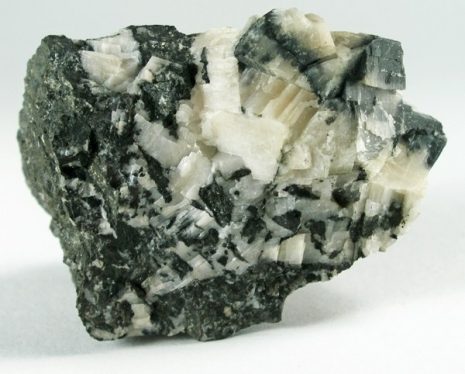
Berzelianite , Calcite Locality: Skrikerum Mine (Skrickerum Mine), Valdemarsvik, Östergötland, Sweden Size: 5.4 cm x 3.6 cm x 3.4 cm Berzelianite is a rare copper selenide and this old-time specimen is from the Type Locality in Sweden. Silvery bright berzelianite flakes and plates are included in calcite. The calcite fluoresces a modest purple. Ex. Charles Velte Collection. Highly representative. — Photo: Robert M. Lavinsky · CC BY-SA 3.0
Berzelianite
A rare copper selenide occurring as dendritic crusts and fine inclusions; its tetragonal dimorph is bellidoite.
Intro adapted from Wikipedia (CC BY-SA).
Berzelianite is an IMA-recognized mineral species in the sulfide class, with the chemical formula Cu₂₋ₓSe (x ≈ 0.12).
It crystallizes in the cubic crystal system (space group F-43m).
Key properties: Mohs hardness 2.7; specific gravity 6.71; Shining streak; Metallic. Anisotropism: Isotropic, may be slightly anisotropic. R: (400) 25.8, (420) 28.9, (440) 30.0, (460) 30.7 luster.
IMA symbol Brz, grandfathered status — known before the IMA’s founding, named in 1832.
With other selenides in hydrothermal veinlets in dolostone (Clausthal, Germany); in iron ores (Lerbach, Germany); with other selenides in calcite veins in serpentine (Skrikerum, Sweden); in a gold-quartz-orthoclase deposit (Redjang-Lebong.
It is found associated with Eucairite, clausthalite, tiemannite, umangite, klockmannite, aguilarite, crookesite, athabascaite, stromeyerite, polybasite, pearceite, gold, uraninite.
The name refers to Jöns Jacob Berzelius (1779–1848), Swedish chemist, who discovered selenium.