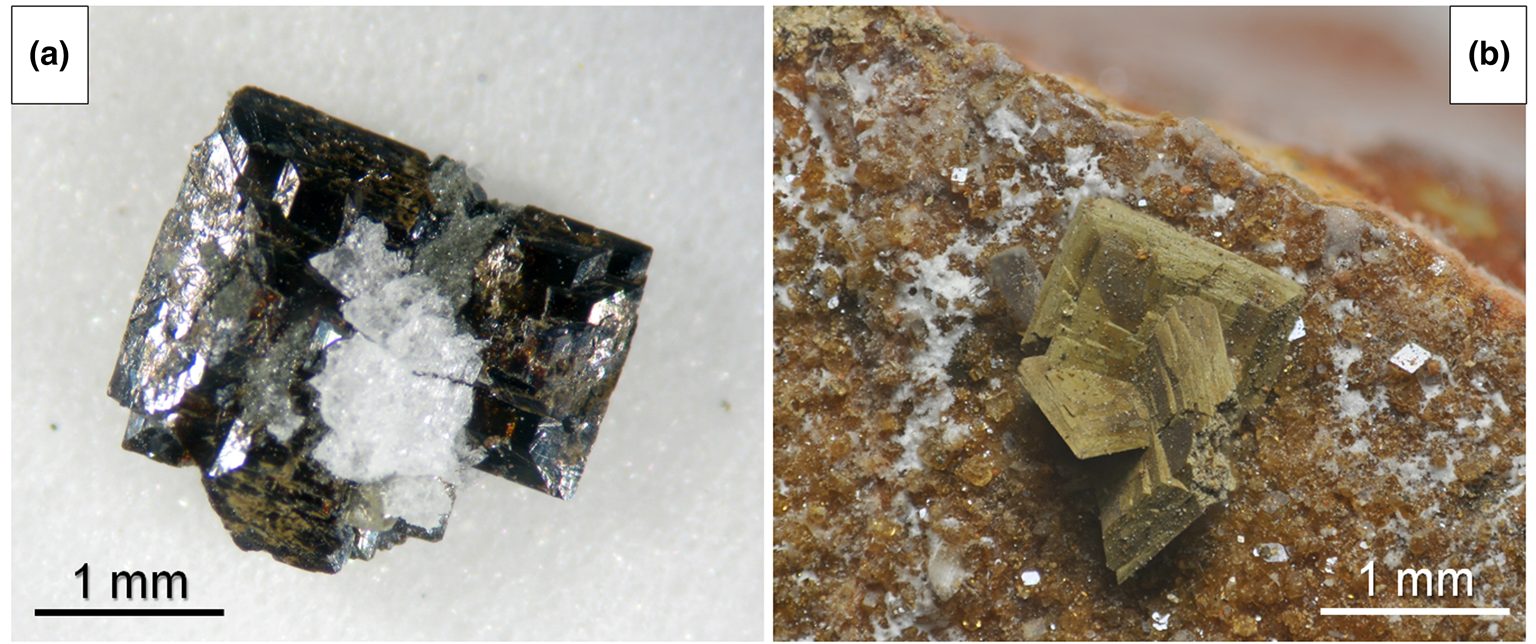
(a) A loose aggregate of tabular crystals of bianchiniite, associated with ‘hyalophane’ and ‘chlorite’. Holotype material was sampled from this specimen. (b) Deeply altered earthy tabular crystals of bianchiniite associated with rhombohedral crystals of siderite and whitish microcrystalline fibrous aragonite. Both specimens from the Sant'Olga level, Monte Arsiccio mine, Stazzema, Apuan Alps, Tuscany, Italy (in a private collection). The image is published in an Open Access article ( https://doi.org/10.1180/mgm.2021.28 ), distributed under the terms of the Creative Commons Attribution licence ( https://creativecommons.org/licenses/by/4.0/ ), — Photo: Biagioni, C., Pasero, M., Hålenius, U., & Bosi, F. · CC BY 4.0
Bianchiniite
Bianchiniite is an IMA-recognized mineral species in the arsenate class, with the chemical formula Ba₂(TiV)(As₂O₅)₂OF.
It crystallizes in the tetragonal crystal system (space group I4/mcm).
Key properties: specific gravity 4.863; Brownish streak; Vitreous luster.
IMA symbol Bcn, IMA status: approved, named in 2019.
Probably related to the circulation of As-rich hydrothermal fluids during the tectono- metamorphism of a pyrite ± baryte ± iron-oxide ore deposit in meta-dolostone.
It is found associated with Baryte, “halophane”, “chlorite”, galena, siderite, aragonite.
The mineral was named to honor mineral collectors Andrea Bianchini (b. 1959) and Mario Bianchini (b.