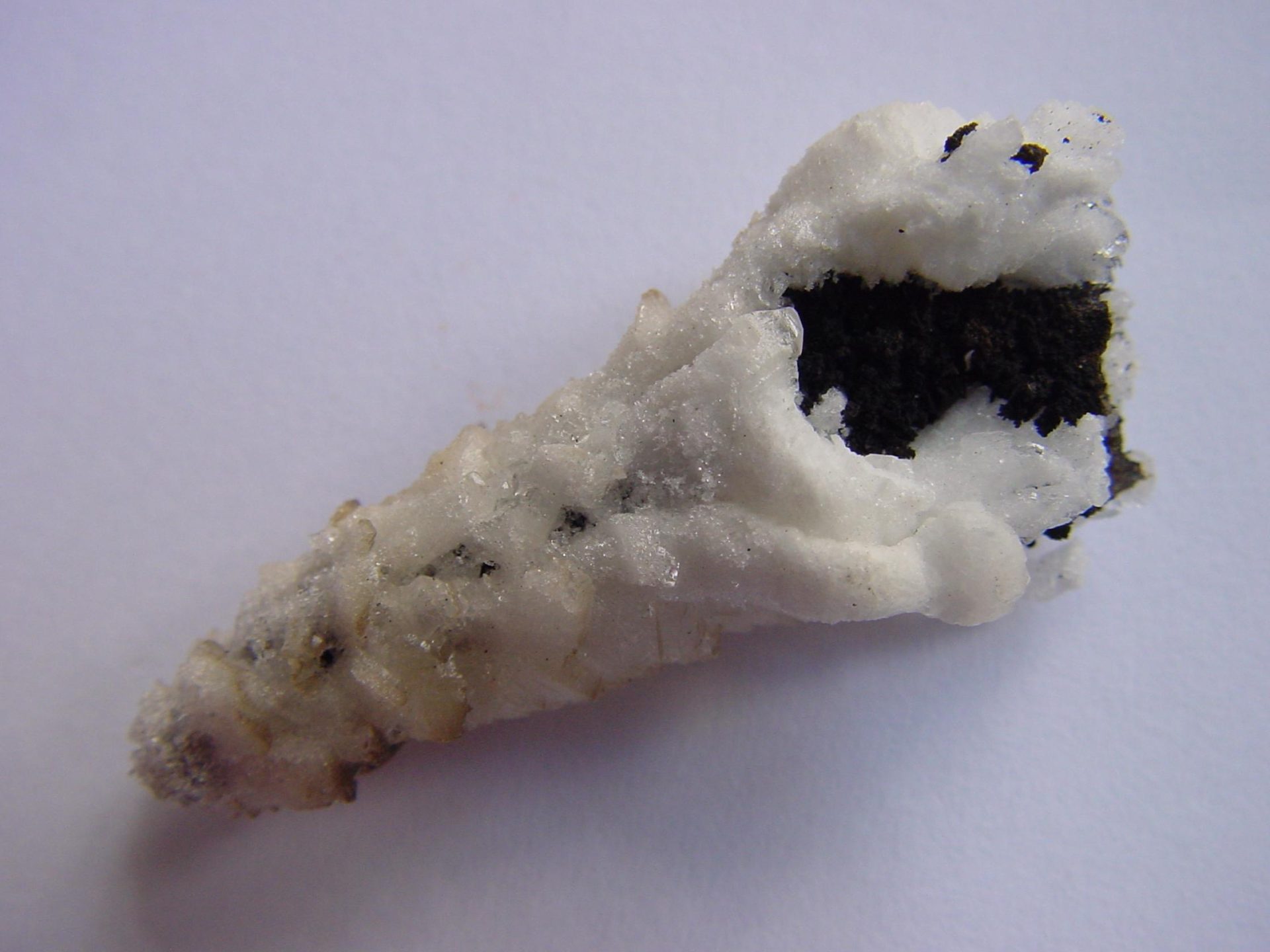
Birnessite (black) or aragonite (white) from the 300' Level, Gold Hill Mine, Clifton District, Tooele County, Utah, USA. Specimen size: 4 cm — Photo: Strickja · Public domain
Birnessite
A poorly crystalline hydrous manganese dioxide — the main manganese mineral at Earth's surface, forming desert varnish and deep-sea nodules.
Intro adapted from Wikipedia (CC BY-SA).
Birnessite is an IMA-recognized mineral species in the oxides & hydroxide class, with the chemical formula (Na,Ca,K)₀.₆(Mn⁴⁺,Mn³⁺)₂O₄·1.5H₂O.
It crystallizes in the triclinic crystal system (space group C2/m).
Key properties: Mohs hardness 1.5; specific gravity 3; Dull luster; refractive index 1.71; optically uniaxial.
IMA symbol Bir, grandfathered status — known before the IMA’s founding, named in 1956.
A major manganese-bearing mineral of many soils; a common alteration product of manganese-rich mineral deposits; a component of bacterially-precipitated manganese oxides.
It is found associated with Rhodonite, rhodochrosite, tephroite, spessartine, alleghanyite, cummingtonite (Cummington, USA); manganese and iron oxides, calcium carbonate (marine nodules).
The name is taken from the type locality at Birness, Scotland.