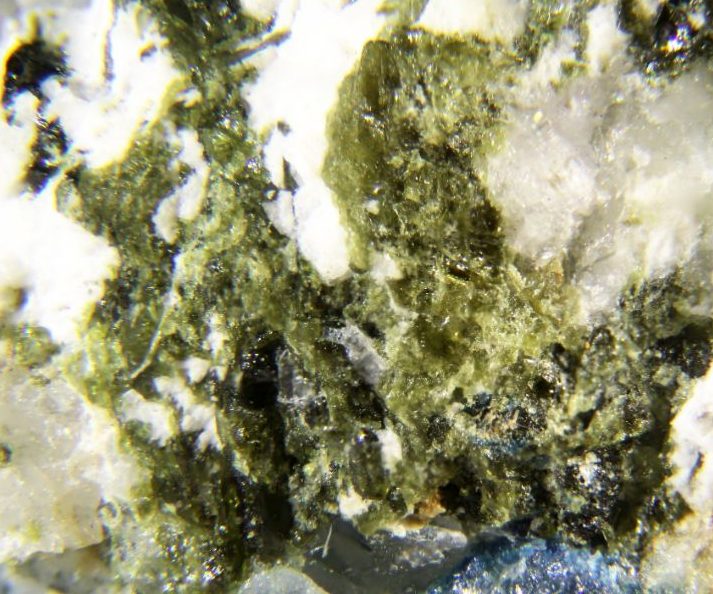
Outstanding for the species dark green crystal aggregates of the very rare phosphate mineral bjarebyite associated to blue burangaite from the TL for the second one: Buranga Pegmatite, Gatumba, Ngororero District, Western Province, Rwanda. Ex Vandenbroucke Museum collection from Waregem, Belgium. — Photo: David Hospital · CC BY-SA 4.0
Bjarebyite
Bjarebyite is an IMA-recognized mineral species in the phosphate class, with the chemical formula BaMn²⁺₂Al₂(PO₄)₃(OH)₃.
It crystallizes in the monoclinic crystal system (space group P2_1/m). It is a member of the Bjarebyite structural group.
Key properties: Mohs hardness 4; specific gravity 3.9–3.95; White streak; Subadamantine luster; optically biaxial.
IMA symbol Bj, IMA status: approved, named in 1972.
A rare late stage reaction product of triphylite and amblygonite in complex granite pegmatites.
It is found associated with Palermoite, augelite, childrenite, montebrasite, scorzalite, whitlockite, carbonate-apatite, siderite (Palermo #1 mine, New Hampshire, USA); bertossaite.
The mineral was named to honor Alfred Gunnar Bjareby (1899–1967), Swedish-American student of New England pegmatite minerals, Boston, Massachusetts, USA, who collected the first specimen.