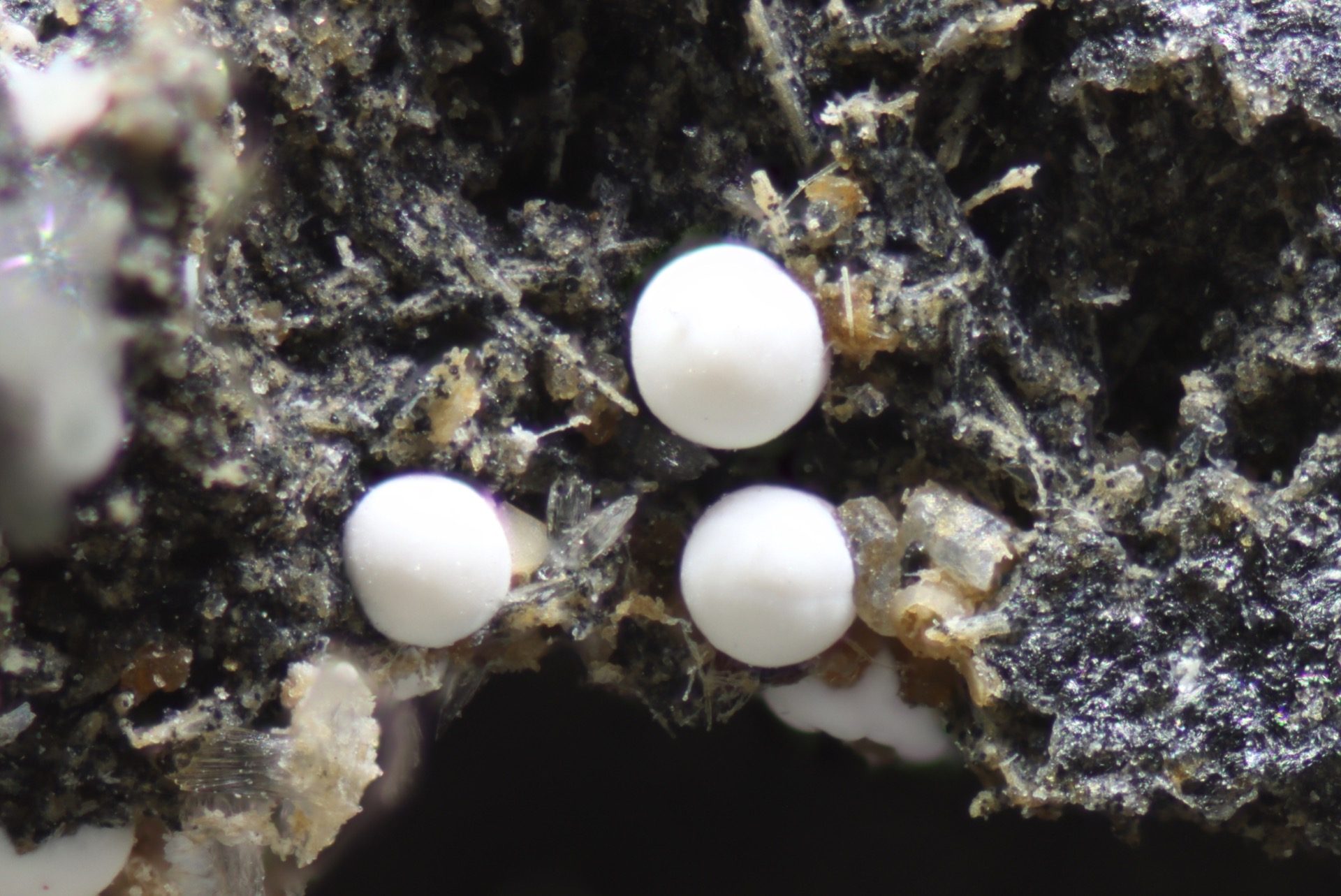
Blixite Field of view: 1 mm Locality: Passa Limani, Lavrion slag localities, Lavreotiki, East Attica, Attica, Greece ( locality at mindat.org ) — Photo: Henk Smeets – tomeikminerals.com · CC BY 4.0
Blixite
Blixite is an IMA-recognized mineral species in the halide class, with the chemical formula Pb₈O₅(OH)₂Cl₄.
It crystallizes in the orthorhombic crystal system (space group C2/c).
Key properties: Mohs hardness 3; specific gravity 7.35; Pale yellow streak; Vitreous, may be dull luster; optically biaxial.
IMA symbol Blx, IMA status: approved, named in 1958.
Found in hausmannite-rich dolomite and manganophyllite skarn in a metamorphosed Fe-Mn orebody (Långban, Sweden); a reaction product in slag immersed in sea water (Laurium, Greece).
It is found associated with Dolomite, hausmannite, copper, manganophyllite (Långban, Sweden); mendipite, anglesite (Elura deposit, Australia); brucite, mereheadite, mendipite, cerussite.
The name refers to Dr. Ragnar Blix (1898-1985), chemist at the Swedish Museum of Natural History, who performed analyses of many Långban minerals.