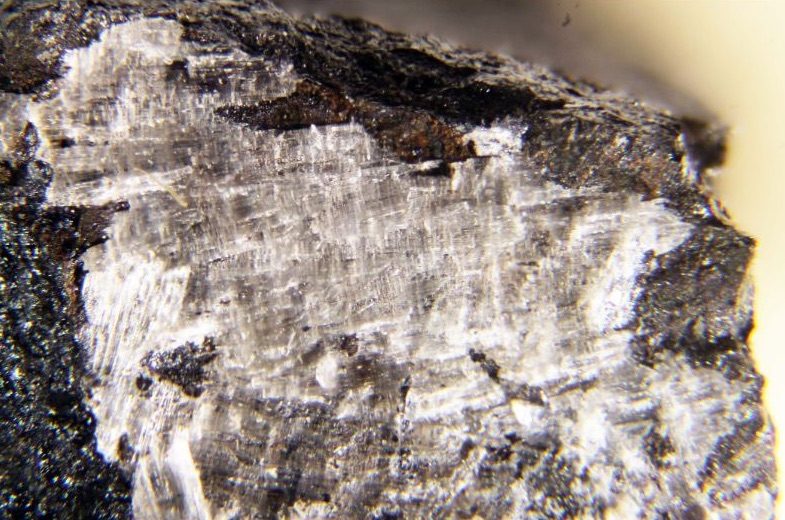
Platy white crystals of the rare bobierrite from a little known locality in Australia (Wodgina, Abydos Station, Port Hedland Shire, Pilbara Region, Western Australia, Australia). Very rare from this locality. Ex Vandenbroucke Museum collection from Waregem, Belgium. — Photo: David Hospital · CC BY-SA 4.0
Bobierrite
Bobierrite is an IMA-recognized mineral species in the phosphate class, with the chemical formula Mg₃(PO₄)₂·8H₂O.
It crystallizes in the monoclinic crystal system (space group C2/m). It is a member of the Vivianite structural group.
Key properties: Mohs hardness 2–2.5; specific gravity 2.195; Nearly vitreous to pearly on cleavages luster; optically biaxial.
IMA symbol Bob, grandfathered status — known before the IMA’s founding, named in 1868.
Formed from the chemical alteration of guano deposits (Mejillones, Chile; Imperial Canyon lava tubes, Kenya), and an elephant tusk (Edgerton, Minnesota, USA). As a rare alteration product of primary phosphate-bearing minerals (Wodgina.
It is found associated with Hannayite, schertelite, lithiophilite, sicklerite, purpurite, collinsite, apatite, dolomite, calcite.
In honor of Pierre Adolphe Bobierre (1823–1881), French agricultural chemist, who first described the mineral.