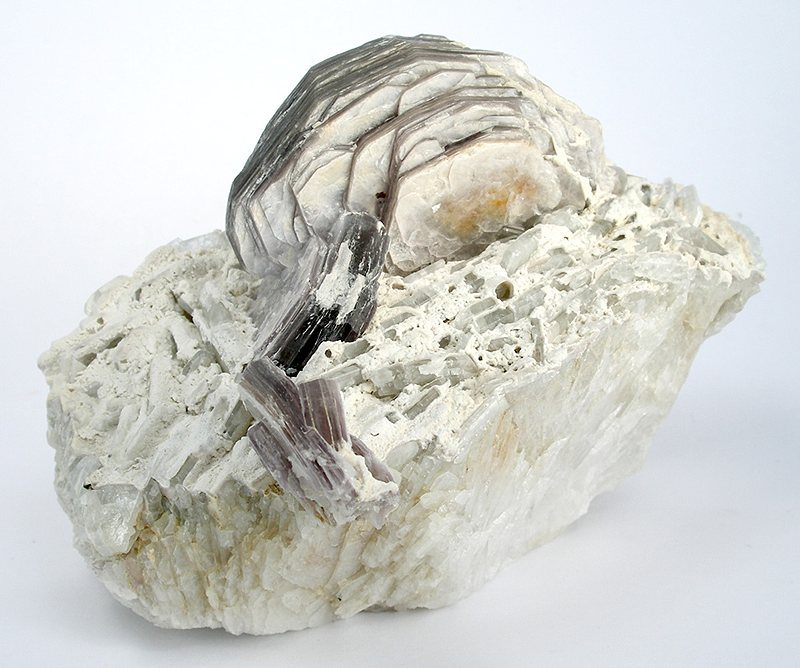
Boromuscovite , Lepidolite Locality: Little Three Mine (Little 3), Ramona District, San Diego County , California , USA ( Locality at mindat.org ) Size: small cabinet, 10 x 8 x 7 cm Lepidolite with Boromuscovite (boron-rich NEW SPECIES) A really fine and attractive lepidolite crystal cluster from anywhere, but especially from San Diego County. This is not just an aside or an association of muscovite here, but rather the new species boromuscovite is present in abundance here as the white earthy stuff. It's a nice example, very rich. The large Lepidolite crystals in middle are 5 cm wide, and have a beautiful metallic lustre, almost a lavender color to them. These specimens came out of one pocket in the 1976 "New Spaulding pocket" and were extensively studied by Gene Foord, for their unusual chemistry. Recently, this muscovite variant has been formally accepted as a new species (thanks to Dr. Robert Lauf for clarifying this for me). Ex. Chuck Houser and Chris Korpi Collections. — Photo: Robert M. Lavinsky · CC BY-SA 3.0
Boromuscovite
Boromuscovite is an IMA-recognized mineral species in the silicate class, with the chemical formula KAl₂(Si₃B)O₁₀(OH)₂.
It crystallizes in the monoclinic crystal system (space group C2/c). It is a member of the Mica structural group.
Key properties: Mohs hardness 2.5–3; specific gravity 2.81; White streak; Dull, earthy to porcelaneous luster; optically biaxial.
IMA symbol Bms, IMA status: approved, named in 1989.
A coating on other minerals on the floor of a pegmatite pocket, hydrothermally deposited after rupture of the pocket.
It is found associated with Lepidolite, quartz, microcline, topaz.
Presumably for the BOROn content and relation to muscovite.