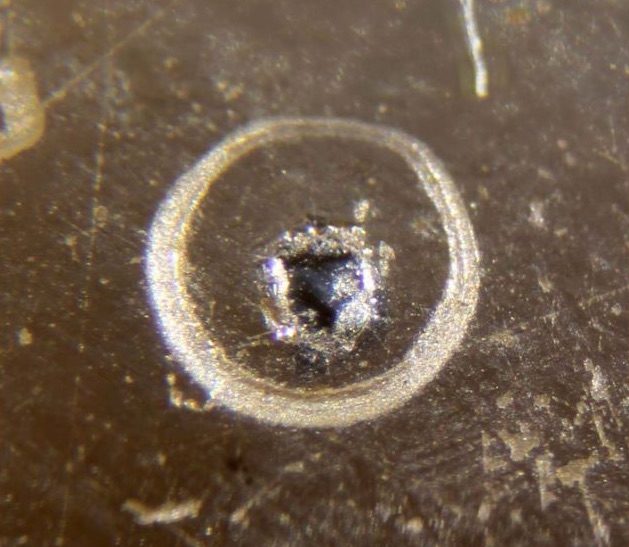
Cylindrical polished section of a nugget of the extremely rare rhodium mineral bowieite in a completely analyzed specimen by SEM/EDS. Carbon and oxygen in the analysis are due to O2 / CO2 impurities in the vacuum chamber where the spectrum is performed. Percent values of PGM metals are approximate, not exact. From: Salmon River, Goodnews Bay, Bethel Borough, Alaska, United States of America. Ex Vandenbroucke Museum collection from Waregem, Belgium. — Photo: David Hospital · CC BY-SA 4.0
Bowieite
A rhodium-iridium-platinum sulfide found in placer nuggets at Goodnews Bay, Alaska, named for mineralogist Stanley Bowie.
Intro adapted from Wikipedia (CC BY-SA).
Bowieite is an IMA-recognized mineral species in the sulfide class, with the chemical formula Rh₂S₃.
It crystallizes in the orthorhombic crystal system (space group Pnca). It is a member of the Bowieite structural group.
Key properties: Metallic. Anisotropism: Weak, dark gray to very dark brown. R1 –R2: (400) 43.5–44.5, (420) 44.2–45.2, (440) 44.8–45.8 luster.
IMA symbol Bow, IMA status: approved, named in 1980.
Found in platinum alloy nuggets recovered from dredging operations (Salmon River, Alaska, USA); in platinum-bearing ultramafic rocks intruded into a granite gneiss-“hornblende” gneiss complex (Gaositai, China).
It is found associated with Platinum-iridium, platinum, osmium, laurite, silicate inclusions (Salmon River, Alaska, USA).
The mineral was named to honor the Scottish scientist, Dr. Stanley Hay Umphray Bowie (1917–), of the Institute of Geological Sciences, London, England.