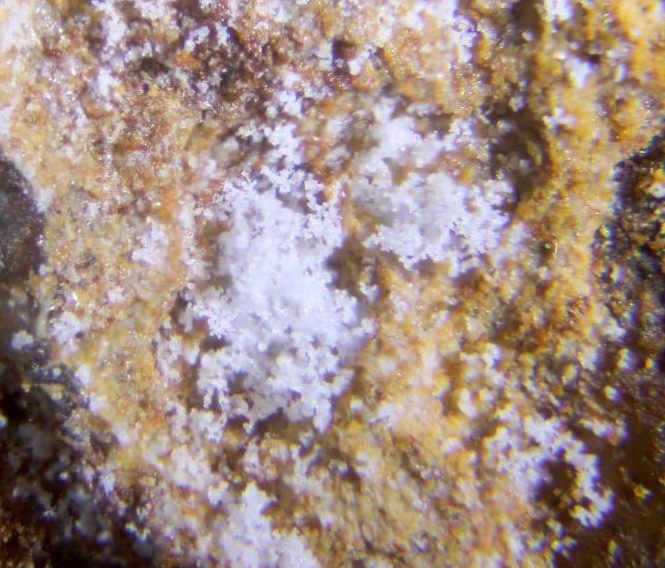
White microcrystals similar to efflorescenses of this very rare Zn-Mg sulphate mineral boyleite from the type locality in Germany (Porphyry Quarry, Dossenheim, Rhein-Neckar, Karlsruhe, Baden-Württemberg, Germany), in a dark contrasting matrix. Ex Vandenbroucke Museum collection from Waregem, Belgium. — Photo: David Hospital · CC BY 4.0
Boyleite
Boyleite is an IMA-recognized mineral species in the sulfate class, with the chemical formula Zn(SO₄)·4H₂O.
It crystallizes in the monoclinic crystal system (space group P2_1/n). It is a member of the Starkeyite structural group.
Key properties: Mohs hardness 2; specific gravity 2.41; White streak; optically biaxial.
IMA symbol Boy, IMA status: approved, named in 1977.
A rare alteration product of sphalerite in a hydrothermal Pb–Zn vein (Kropbach quarry, Germany).
It is found associated with Gypsum, gunningite, sphalerite (Kropbach quarry, Germany); gunningite, coquimbite, zincocopiapite, jarosite, melanterite, römerite, siderotil, voltaite.
The mineral was named to honor Dr. Robert William Boyle (1920–), Canadian geochemist, Geological Survey of Canada, Ottawa, Canada.