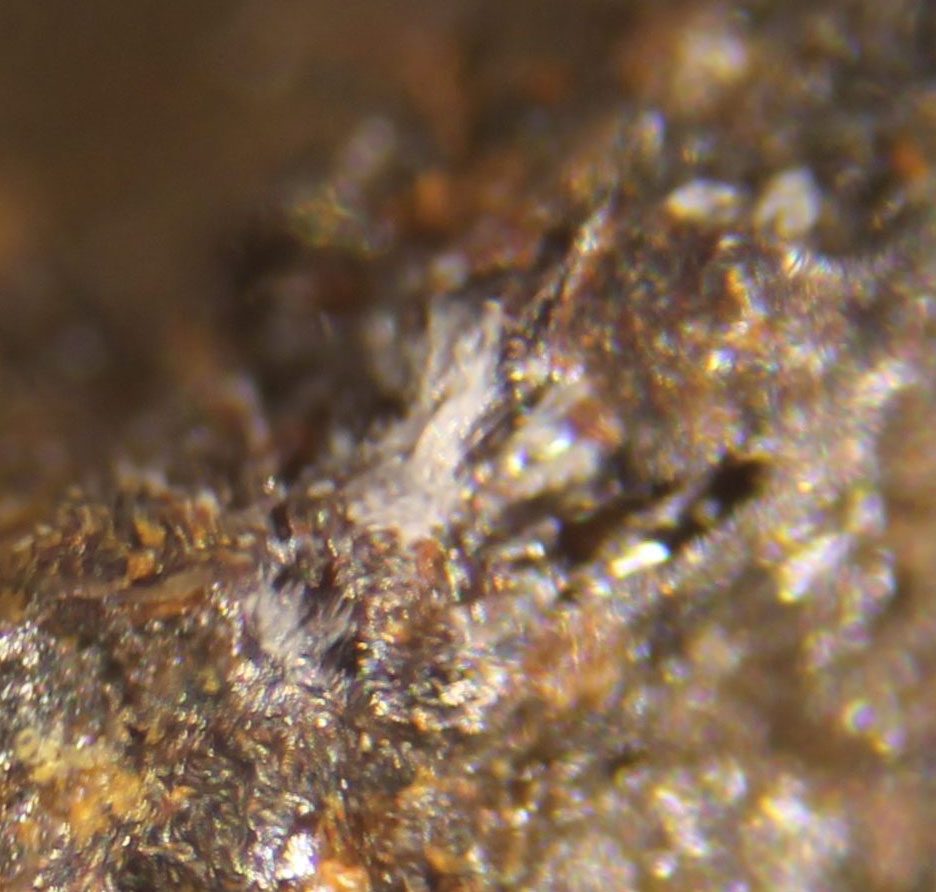
Small white microcrystals of the extremely rare mineral brianite from the type locality in Dayton meteorite (Dayton Meteorite, Montgomery County, Ohio, United States of America) and only of the three known localities worldwide (all of them meteorites). Brianite is a Na-Ca Mg phosphate. — Photo: David Hospital · CC BY-SA 4.0
Brianite
A sodium-calcium-magnesium phosphate first identified inside an iron meteorite, named for meteoritics pioneer Brian Mason.
Intro adapted from Wikipedia (CC BY-SA).
Brianite is an IMA-recognized mineral species in the phosphate class, with the chemical formula Na₂CaMg(PO₄)₂.
It crystallizes in the monoclinic crystal system (space group P222). It is a member of the Aphthitalite structural group.
Key properties: Mohs hardness 4.5; specific gravity 3–3.3; refractive index 1.604; optically biaxial.
IMA symbol Bne, IMA status: approved, named in 1966.
A very rare component in phosphate nodules in an iron meteorite.
It is found associated with Panethite, whitlockite, albite, enstatite, schreibersite, kamacite, taenite, graphite, sphalerite, troilite.
In honor of Dr. Brian Harold Mason (1917–), U.S. National Museum, Washington, D.C., USA, for his contributions to the study of meteorites.