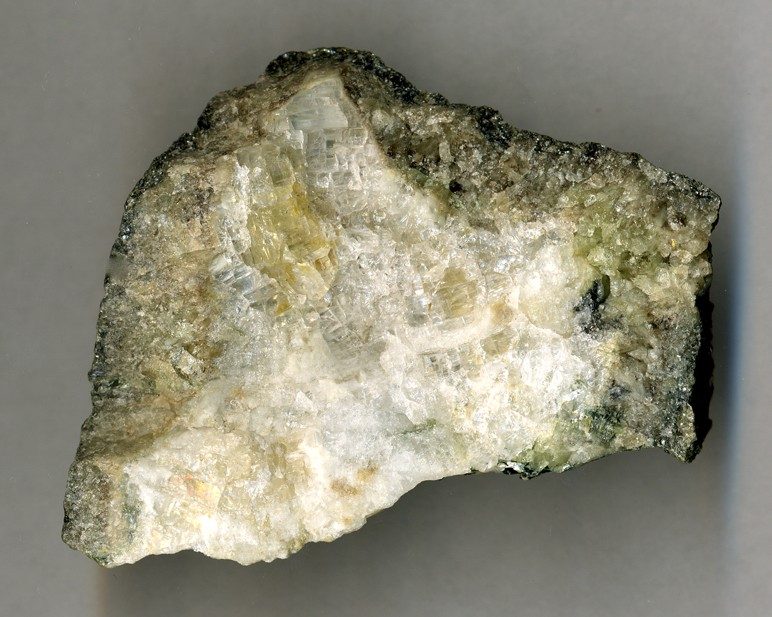
Bromellite , Phenakite , Chrysoberyl , Phlogopite Specimen size: 8 cm x 5 cm x 3 cm Locality: Malyshevskaya pit, Malyshevskoe deposit (Mariinskoe), Izumrudnye Kopi area, Malyshevo, Ekaterinburg (Sverdlovsk), Sverdlovskaya Oblast', Middle Urals, Urals Region, Russia Original description: Agregate of large cm-size transparent, colourless and slightly yellowish crystals of bromellite cemented by white, granular, sugar-like phenakite masse. This agregate divided from phlogopite shist by crust of olive-green crystaline chrysoberyl. Collected in 2000. Pavel M. Kartashov collection (#2050) and photo. — Photo: Pavel M. Kartashov · CC BY-SA 3.0
Bromellite
The mineral form of beryllium oxide — a white mineral of complex pegmatites, named for Swedish chemist Magnus von Bromell.
Intro adapted from Wikipedia (CC BY-SA).
Bromellite is an IMA-recognized mineral species in the oxides & hydroxide class, with the chemical formula BeO.
It crystallizes in the hexagonal crystal system (space group P6_3mc).
Key properties: Mohs hardness 9; specific gravity 3.017; Vitreous luster; refractive index 1.726; optically uniaxial.
IMA symbol Bmel, grandfathered status — known before the IMA’s founding, named in 1925.
Found in hydrothermal calcite veins and veinlets in hematite skarn and skarnized limestones (Långban, Sweden); in vugs in natrolite, hydrothermally altered from nepheline, in syenite pegmatite (Langesundsfjord, Norway).
It is found associated with Swedenborgite, richterite, manganophyllite (Långban, Sweden); natrolite, diaspore, chamosite (Langesundsfjord, Norway).
The name refers to Magnus von Bromell (1679–1731), Swedish physician and mineralogist.