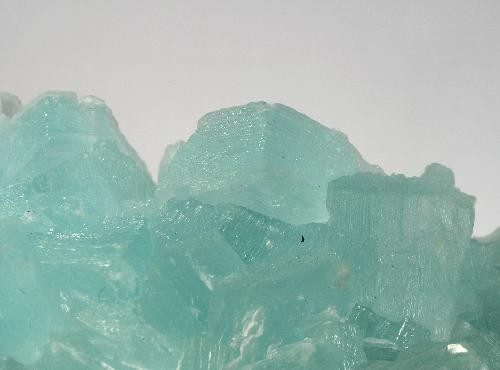
Brucite Locality: Palabora mine, Loolekop, Phalaborwa , Limpopo Province , South Africa ( Locality at mindat.org ) Size: 8.4 x 4 x 2.6 cm. A fine, very attractive intense pastel-blue Brucite specimen with sharp crystals of unusually good quality. The edges of the piece are contacted, but the crystals along the edges and at the core are in excellent condition and have very good color for the material. The translucent to gemmy crystals have well-defined terminations and range up to 1.5 cm long and 1 cm across, exceptional for brucite from the locality. Ex. Charlie Key stock. — Photo: Robert M. Lavinsky · CC BY-SA 3.0
Brucite
Natural magnesium hydroxide — a common alteration product in serpentinized peridotite and metamorphosed limestone.
Intro adapted from Wikipedia (CC BY-SA).
Brucite is an IMA-recognized mineral species in the oxides & hydroxide class, with the chemical formula Mg(OH)₂.
It crystallizes in the hexagonal crystal system (space group P-3m1). It is a member of the Brucite structural group.
Key properties: Mohs hardness 2.5; specific gravity 2.39; White streak; Waxy, pearly on cleavage surfaces luster; refractive index 1.583; optically uniaxial.
IMA symbol Brc, grandfathered status — known before the IMA’s founding, named in 1818.
A common alteration of periclase in marble; a low-temperature hydrothermal vein mineral in metamorphic limestones and chlorite schists; developed during serpentinization of dunites.
It is found associated with Calcite, aragonite, dolomite, magnesite, hydromagnesite, artinite, talc, chrysotile.
The name refers to Archibald Bruce (1777–1818), physician and early American mineralogist, Professor at the College of Physicians and Surgeons (later Columbia University), New York, New York, USA.